
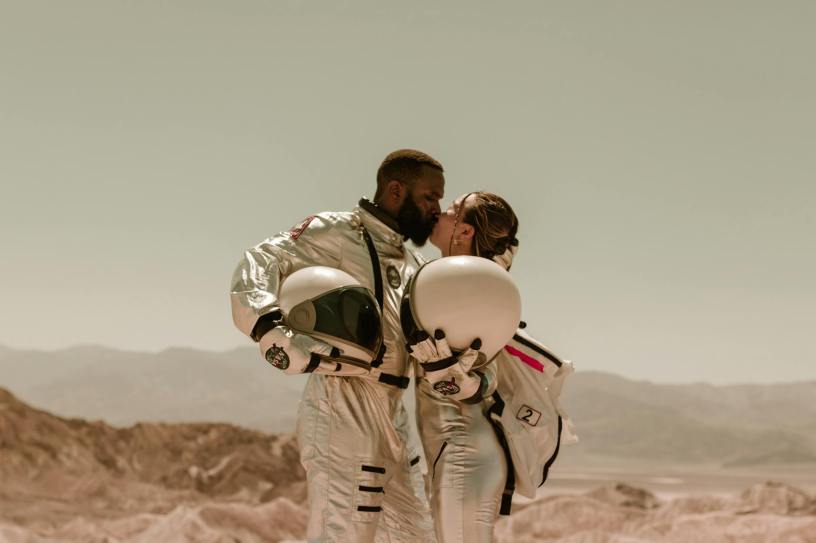


Mars!
It’s fired my imagination for years.
I’ve peered through a telescope at it. It’s a bright disk, and with the right filters, I could even see the ice caps. Occasionally the mind connects dots, real or imagined, and I might see the Canals leap out at me and be gone just like that.
And then came films like Conquest of Space, and even the Martian. They tuned Mars into a place we could not only reach but even live there.
The term colonization means a lot. Mostly, you don’t intend to return. Most of my genetic pool comes from the other side of the ocean. Somewhere in England, Spain, and Lebanon are people I share common ancestors with. Yet, some of my relatives left those places, never to return. Today, about all I have in common with them is last names. And the challenge to return to the ancestral grounds is mostly limited to the price of a ticket.
Returning from a colony on the Moon or Mars would be fraught with issues.
One being if you live too long on either, with the lesser gravity, what does that do to the body. Will you lose the ability to return to Earth at all? In his book, Millenium, Ben Bova addressed that issue with the commander of the American moonbase who needed an auxiliary heart pump and was stuck in a wheelchair while here on Earth. Staying too long on either body could make your move there a one-way trip.
How about offspring? Born on the Moon or Mars, what does that mean to them? Not needing to fight our gravity, what does that mean for their development? In the novelization of 2001, Heywood Floyd encounters the young daughter of a friend. She was born on the moon, isn’t even a teen yet, and is as tall as he is. She’ll grow taller still. He asks her if she ever thought about visiting Earth, and at first, she’s wide-eyed with wonder. Then she describes Earth as a terrible place. You get hurt when you fall down.
And even if she would, consider that the girl has spent her life in an enclosed, controlled environment. What would dropping her in a wide-open space do to her? Would she be filled with wonder or terrified out of her mind? How about rain and snow? What would she think?
And then there’s the simple mechanism of birth. Could a child conceived on the Moon or Mars and carried there to term, even survive a normal birth?
And then there’s the matter of the immune system. Raised or living too long in a controlled environment could lessen the strength of the immune system. What challenges would visitors from Earth bring with them? Could we end up in a situation where the colonists on the Moon or Mars might be wiped out by a simple childhood malady?
I could easily see an Ellis Island arrangement where visitors or immigrants were quarantined until it was deemed they were safe to let in.
One thing we need to keep in mind is that colonization is fraught with peril. If history has taught us anything, it’s that things don’t always go right. How many attempts at colonization have failed right here? How many dead are buried across the world as humans tried to move into a new area. How many Roankes or near disasters like Jamestown have occured.
One thing history has taught is a colony will have to come equipped with a graveyard.
And that opens up another thought. If you die on a Martian colony, what happens to your body? Will you receive a proper burial or cremation like we do here? Or will your remains be viewed as a resource for the farms that feed the colony?
Assuming we don’t blow ourselves up, get wiped out by some plague, or God forbid, fall into another Dark Ages, I’ve no doubt that we won’t have colonies on the Moon or Mars.
But what the colonists will become is anyone’s guess. Homo Astros will be true children of the stars and in a thousand years will be a completely different species. Freed from our environment and challenged by another, about all they’ll have in common with us is last names.
Discover more from William R. Ablan, Police Mysteries
Subscribe to get the latest posts sent to your email.
 William R. Ablan, Police Mysteries
Fantastic post about the possibility of human life on the moon and Mars, Richard!
LikeLiked by 1 person