
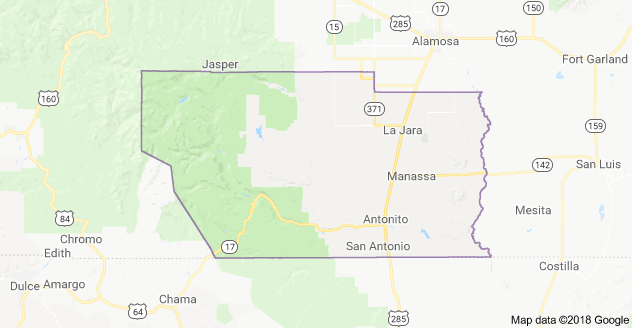
Before the next book comes out, I thought it would be nice if you at least knew a little about the area. Unlike Middle Earth or Narnia, these places exist. so, without further ado . .
ANTONITO-

I’m not native to the town, but I’ll always remember it with fondness. After all, I was a Police Officer there. I lived there. And there are tons of good people there, many who I’m proud to call friends. People like the Madrid’s, the Vigil’s, the Lucero’s. and the Malouff’s.
Antonito began its life as a sheep camp. Back then it was called San Antonio Junction. It got its name because of the location in proximity to the San Antonio and Conejos River. We already had a San Antonio, located a few miles south of the current town of Antonito.
But when the Denver & Rio Grande Railroad ran the line south to that location, a town was created. From it, sheep were moved throughout the nation. The railroad branched out from there, going towards Chama and south to Santa Fe.
The Post Office was moved from nearby San Antonio to the new town of Antonito on 24 Jan 1881. Antonito became an incorporated town on 29 Dec 1889.
If you’re wondering where the name came from, this is it. San Antonio, which the name is derived from the, of course, the major settlement. It was named after Saint Anthony, the patron saint of the settlers and the name of the church. We already had Antonio (it was called San Antonio Junction after all). The “ito” added to the end would roughly translate out as “Little Antonio” or “Antonito.” In this case, the child definitely grew up to be larger than the parent.
Agriculture is still a large part of the local economy. On almost all side of the community we find open fields. Grain and barley are grown, hay for animals, and assorted other cash crops. To the south, there are the perlite plants which employee a fair number of people.
While I’m not a fan of the recreational marijuana industry, it has done much to help the local community and to maintain historic buildings.

One of them is the SPMDTU in middle town. Think of an auditorium/meeting hall for local farm workers you get an idea of its purpose. It’s a mission the goes way back and was and still is an important part of the community. The building and the values continue the mission of making the area a better place to live.
I’ve used it several times to host fund raisers by staging talent shows and the occasional play. They were a lot of fun.

Another historic building is the church in nearby Conejos. Our Lady of Guadalupe has been open to the faithful since 1863. It’s a beautiful structure with a long history. I’m posting a link here for you to check it out. You won’t be disappointed.
Of course, no visit to Antonito would be complete without riding the Cumbres and Toltec Scenic Railroad. Most train rides that are short and over in a few hours. Not this one. Riding these rails is pretty much an all-day experience. Starting in Antonito, the engines roll through some of the most spectacular country in America. They weave their way through Colorado and New Mexico to Chama. Check them out, it’s money well spent.

The Train ride is worth every nickel of the ride. It goes through some of the most spectacular country in America. I’ve ridden it a couple of times and in for me, it’s a journey through my childhood. Places like Osier and Cumbres Canyon are a part of me.
The train has been featured in several movies to include Indiana Jones and the Last Crusade. The house a young Indy runs to is also in Antonito and is now a Bed and Breakfast.
Another curiosity is Cano’s Castle. Cano is a local gentlemen who started building this back in the ’90s. Every piece of the castle is recycled material. I haven’t seen Cano in years, and I don’t know if he offers tours or not. but it’s worth a drive by at least. I asked him why he was building it and he said it was a place where Jesus could stay when he returned.
Recently, the Castle has been closed. The residence Cano resided in burnt down and I don’t know how that impacted things.
CONEJOS/GUADALUPE-
The unincorporated communities of Conejos and Guadalupe are separated by little more than the Conejos River.
Guadalupe was to have been the county seat when the then territory of Colorado was subdivided up into the counties. Its name of course would been Guadalupe County. That changed a week later when the name was changed to Conejos (Spanish name for Rabbit). I’m not sure why the name was changed despite there being a lot of rabbits about. With a stroke of a pen, the county seat was moved across the river in Nov of 1861.
Nearby, Guadalupe was the site of the first flour mill constructed in Colorado. This happened when Lafayette Head, along with fifty Mexican families found the community of Guadalupe in 1854. he first home in Guadalupe was built in 1854 by Jose Jaquez.
A number of the people residing there today can trace their lineage back to the first people to arrive there.
I don’t think anything remains of the mill, but I may be wrong on that.

One of the cool things about the community is the church of “Our Lady of Guadalupe.” It’s the oldest church in Colorado. There have been a couple of fires associated with it. Each time the damage has been repaired, and it remains in use to this day.
Once upon a time, a life size Penitente Cross hung in the church. What happened is we got a new priest who found it in the attic of the church. Hand-carved and probably as old as the church, it represented a major work of art for the area. As Penitente art goes, it was mind boggling. It was so gruesome it was actually beautiful and gives a great feel for the death Jesus died. it was displayed in the church, a representation of the heritage of the people who settled here.
Someone broke into the church in the early 1990s and stole this incredible and priceless artifact. It’s one of the few cases I’ve worked that remains unsolved. I spoke with a man who collected such things, and he put out feelers to see if it turned up. It never has, and the theory is that it’s long since been destroyed. If so, whoever took and destroyed it committed a crime right up there with the Nazis stealing and destroying art. It’s my hope and prayer that it’s in someone’s garage or attic and someday it’ll be found and returned.
A replacement cross was made by local artist Bernal Martinez and hangs in the church today.
In the early 1980s, a fire destroyed the old courthouse. It was an arson and to date, the arsonist has not been identified. The speculation as to why it was burnt has ran rampart. Theories run rampant from an attempt to stop something moving through the courts Or perhaps someone wished to destroy records.
Of course, it could be it was caused by someone who just liked fire. We had several major fires in the decade or so leading up to the courthouse fire. All under suspicious circumstances (to include the church in Mogote). So we may have had a simple pyro on our hands.
I was a witness to the event and trust me, it was a circus. We had four fire departments on the scene, and it couldn’t be saved.
A new courthouse was constructed and remains in use to this day.

In Event Horizon, Will’s buddy Jonesy comments on the new courthouse. Will tells him about how the old one burnt down. Jonesy asks what it looked like, and Will says, “Like Norman Bates lived there!”
The Sheriff’s Office I use in my stories was behind the courthouse. Built in the 1940s, it was increasingly difficult to make it meet jail standards. It was closed and a new office built about a mile away.
The old jail has since been repurposed into office space, and the building is still in use.
West of Antonito, and going up into Conejos Canyon, there’s a number of small towns. We call them “Placitas”, and many were once towns in their own rights. The majority of them centered around the small churches, most of which still exist. They had a small core of citizens that filled the same job as a mayor and town counsel. Today, many of them are little more than a few homes that are still occupied. A large number of the older homes are now ruins.
A mutual friend of JR and mine by the name of Rick Vigil has begun building up a video history of these small communities. He’s doing a great job of recording stories of the people and communities. Here’s a link to his story of San Rafael.
PAISAJE-
Some of the locals call this place San Rafael after the church there. Personally, I wonder if it’s because they can’t pronounce the proper name. Paisaje means “Pretty Place” in Spanish. I would say the name fits. It has awesome meadows around it and a great view of the mountains.

Once it was a of going concern with stores and what amounted to a department store. But that was long ago and except for the church, all that remains is a handful of homes.
A historical note – The Espinoza Brothers who terrorized swaths of Colorado during the 1860s were from this area. Depending on the history you read, they were either serial killers, cold blooded murderers, or freedom fighters. Either way, they left a lot of people dead in their wake. I wrote a piece on them as part of the Bad Guys of the San Luis Valley. Read it here.
A literary note – In my novels, the Sheriff and his family reside in San Rafel. RJ, up to the time he met Pam, called this place home.
JR tells me the story of when his father passed away, he and his aunt went to the church in the picture. There, they rang the bell several times. I’m not sure where the custom of ringing the church bells when someone died passed, came from. But to me, it was a deeply humble and profound way to honor a man I looked up to.
SAN ANTONIO/ORTIZ/LAS MESITAS/MOGOTE/CANON

These are a few more small towns in the area. There’s not a whole lot to them, though they’re filled with grasslands and homes. Like Paisaje, they were serious towns once. I want to draw your attention to Mogote if I could. If you were westbound on Highway 17 through it, you’ll see a bluff directly ahead.
On it is a cross that has a really interesting story behind it. I’ve a link below on it.
Before I left for the Army I spent several months getting in good physical condition. Part of my test to ensure I was ready was to scale the hill up to the top. I did it in February or I’d have run into more than a few snakes.
Snakes are one of the animals on God’s green Earth I do not enjoy encountering.
BEFORE MOVING ON
Antonito was a hub for railroad activity. If you look at the map below, you’ll see a line that ran from Antonito to Santa Fe, New Mexico. The Rail line doesn’t exist anymore, but in its time, it was vitally important.
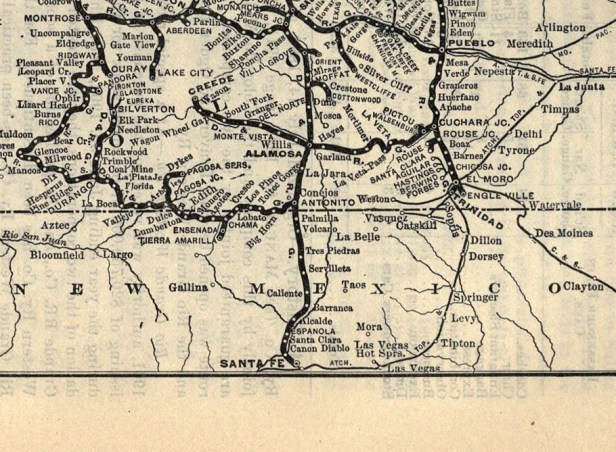
The locals called it “the Chili Line.” It was built to bring in produce from farms in Northern New Mexico. It was an attempt by the Rio Grande Railroad to get into territories belonging to other railroads. When the line was abandoned, it sentenced the town of Antonito to a slow decline.
The Chili Line formed a vital link to the communities. There are stories of the engineers doubling as paper boys and bringing the latest news to otherwise isolated towns. Sometimes they stopped and emptied hot water from the train boilers for women to wash clothes in. Had it still been in existence, it may have played a vital role in the construction of the A-bomb and America’s war industry during WW II.
Discover more from William R. Ablan, Police Mysteries
Subscribe to get the latest posts sent to your email.
 William R. Ablan, Police Mysteries
Great information, Richard!
LikeLike
The place has a ton of history. Some fo teh stuff that happened her sounds like the a western. I guess the stories had to come from someplace.
LikeLiked by 1 person