

James was part of the generation that did math with pencils.
I worked for an Internet Service Provider, and James was having problems with the Internet. He lived in senior housing, and since I couldn’t fix him remotely, I told him I’d drop by after work.
His apartment was what would be called “senior-citizen chic.” It had a small kitchen, bath, and bedroom. His computer sat on a desk in the living room next to his television and VCR.
What caught my eye were his decorations. Framed on the wall was a chart showing the north coast of Russia. It had a course penciled in that skirted Russian airspace but stayed in international airspace. A slide rule was next to it. In the middle of the map was a picture of what looked like a B-29 bomber.
It’s not a B-29,” he said. “Ever heard of the B-50?”
I had.
Boeing, the company that had built the legendary B-29, was always doing upgrades on the plane. What they’d done was to take the B-29 and gave it a higher tail surface. It had better metal, more powerful engines, and Boeing said it was a whole new bomber.
Needing something to carry the Atom Bomb into Russia, the Air Force bought it.
It would be the last fully piston-powered bomber in the Air Force inventory. Soon it would be replaced by more powerful aircraft like the B-52. This left the aircraft to perform roles such as recon, refueling, and weather.
“I was a navigator on a WB-50,” he said. “The ‘W’ stands for Weather.”
“That’s the Russian coast,” I said, looking at the chart.
“We flew the B-50 up and over the pole to collect weather data. It was important because if things kicked off between us and the Russians, we had to know what the weather was for our bombers going in. Some of our work helped make the U-2 flights possible, you know, like the one Gary Powers flew.”
I was familiar with Gary Powers and his disastrous flight.
“We also sniffed the air, looking for evidence of atomic testing. If we saw an increase in fallout, it was a sure bet the Russians had tested a bomb.”
“Some of the B-50s monitored radar and radio transmissions. Some had high-resolution cameras. But we were all about the weather.
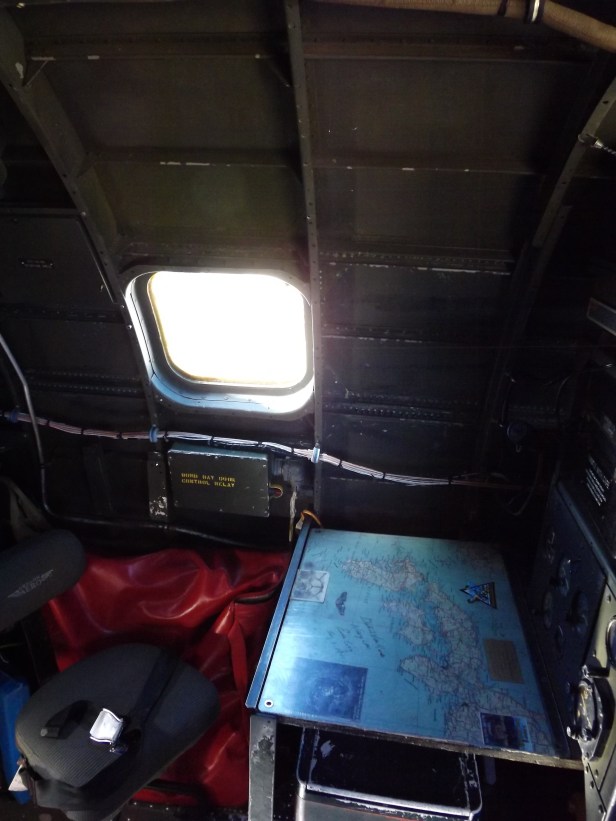
“My job was pretty ticklish. We had to fly an exact course right along the edge of international airspace. Off a little and we’d be in Russian airspace and legal prey for their fighters. Too far out, and we wouldn’t know what the weather looked like. It could get a little tense.”
“The Russians probably didn’t like your being there.”
“No, they didn’t. I’m sure they knew we were just a weather plane. But we were still a bomber. They kept an eye on us. They were just letting us know they cared.”
“Was this your first flight?” I asked. He’d kept the chart for a reason.
“It was, and I’d never seen a MiG till then.
“We were flying in daylight. I remember the sky was amazingly clear. There wasn’t even a cloud, and we were flying at about twenty-five thousand feet. The B-50 was pressurized, so we didn’t have to wear masks. It was warm, but we still wore our jackets.
“Looking out one side of the plane, I could see this vast expanse of ice. Sometimes lines crossed it that looked like roads. They were pressure ridges in the Artic ice, the place where ice comes together and buckles.
“On the other side was Russia. If I got up to look out that window, I could see snow and mountains, and the glint of sunlight off glass or metal.
“It had been a routine flight without problems. The engines were a steady drone, and we did our job, talking back and forth. I checked our position constantly. We were just inside international airspace. A mistake could endanger us.
“That there had been flights into Russia wasn’t a secret in the flying community. Some had ended in disaster. Our job was to collect weather data, not spy. We were being careful.
“Then the pilot said over the intercom, ‘We’ve got company.’
“I looked out my porthole. Off to one side of us, maybe a hundred yards beyond our wing, was a MiG-19. I could see the red star painted on it. The pilot, his face hidden behind goggles and a mask, was looking at us. I bet he was thinking, ‘My, what a big target.’
“There’s another on this side,’ a voice said in my intercom.
“I went to the other window and saw another MiG off the other wing.
“‘There’s one on our six,’ someone else reported.
“We flew like that for several minutes. I kept looking at the fighter off our left wing, and it appeared to be slowly closing. I reported that, and the pilot said, ‘I’m watching him. He is crowding us just a little.’ Then he added, ‘I know you’re new. This is routine. Happens all the time. It’s like a shark following a yacht. As long as no one does anything stupid, it’s fine.”
“The instinctive thing to do would be to maintain our distance. That would have meant turning a bit, and that would have taken us into Soviet airspace in minutes.
The MiG kept getting closer. Our pilot maintained his course, not moving an inch to the right or left.
“Finally, maybe ten meters away, the MiG stopped its approach. It flew like that with us for a few minutes. I could clearly see the pilot. We were close. A tiny mistake could have frightening consequences.
“I felt I had to do something, so I did the only thing I could think of. I held out my hand to the window, with the time-honored middle finger extended.
“He probably never saw my gesture.
“But it sure made me feel better!”
Check out the broadcast on Our American Stories.
If you’re a Veteran in crisis or concerned about one, connect with our caring, qualified Veterans Crisis Line responders for confidential help. Many of them are Veterans themselves. This service is private, free, and available 24/7.
Here’s how you can connect with a Veterans Crisis Line responder, anytime day or night:
- Call 988 and select 1.
- Text 838255.
- Start a confidential chat.
- If you have hearing loss, call TTY: 800-799-4889.
If you’re not a veteran or wish you can also take these actions:
- Call 911.
- Go to the nearest emergency room.
- Go directly to your nearest VA medical center. It doesn’t matter what your discharge status is or if you’re enrolled in VA health care. if not a veteran, go to your nearest hospital.
Find your nearest VA medical center
Discover more from William R. Ablan, Police Mysteries
Subscribe to get the latest posts sent to your email.
 William R. Ablan, Police Mysteries
Fascinating, William.
LikeLiked by 1 person
Scary job I’m sure.
LikeLiked by 1 person
Wow!
LikeLiked by 1 person
The stories we never hear. I’m thinking of entering this one in the VA competition this year.
LikeLiked by 1 person
Go for it!
LikeLike
That would be scary. It’s good none of the MiG pilots decided to shoot them down for the fun of it.
LikeLike
There had been incidents on both sides of the equation. One day, I might write about them
LikeLiked by 1 person