
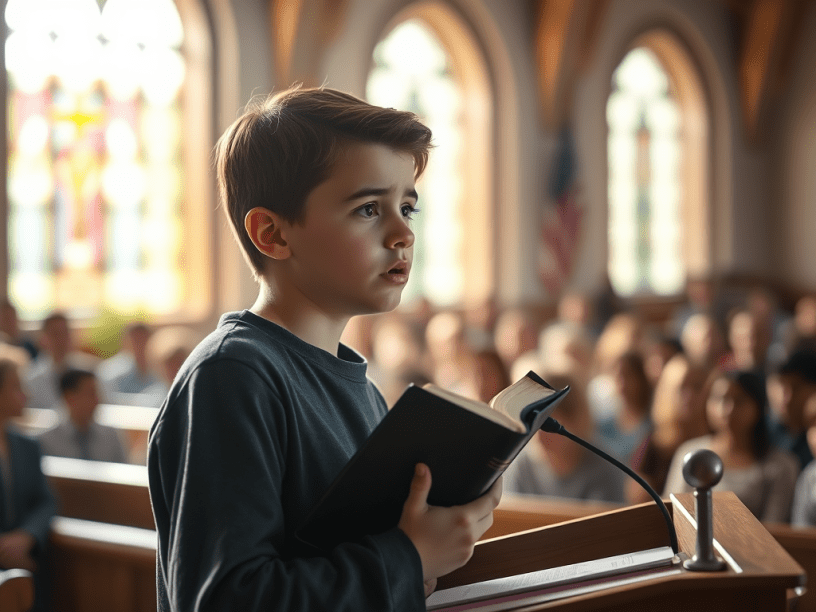


That’s easy. Public speaking and here’s how I did it.
NOTE: I’ve spoken about this before, but here it is again.
For many, the idea of speaking in public is about as close an approximation to hell as you’re likely to get.
People find that their voice quivers.
Their mind goes blank.
The break out in sweats.
And it takes everything they have to get from “Good morning” to “Thank you.”
Been there. and it started for me at age ten.
It was Sunday morning. I’m standing on a milk crate behind a pulpit.
I’m reading from the Bible to a crowded church.
It was big thick Bible written in old English. You know, the kind with words this kid from Colorado had never seen (want to know how I pronounced “gentiles”? Well, it had more to do with the medical pronunciation of reproductive organs).
To be sure, it was a totally unnerving, lackluster performance.
When finished, I crawled out from behind the pulpit. My face was red with embarrassment, and I was totally relieved the ordeal was over.
“Not to worry,” Fr. Verde said after services. “You’ll do better next week.”
Excuse me?
Next week!
There was more of this ahead?
I thought about it all, and thought, like hell I’m going through this again.
But I had too much respect for the man to say otherwise.
Dad was, of course, was his compassionate self when I expressed my fears to him. “What happens when you get tossed from a horse?”
Well, every cowboy worth his salt knows that answer. You get up and, grab your hat. You dust off your pants, pull the cactus thorns from your butt, and you climb back on.
So, I cowboyed up and began studying public speaking. To be sure, there wasn’t much to be found at the grade school level. I began talking to my teachers on the subject and many were willing to help.
One of the first things I was asked was why I had a problem?
Well, I was a last-minute replacement (the lector came down with the flu and his backup wasn’t in church). Add to that that every one of my teachers knew I was a stutterer. So, I got three pieces of advice that proved invaluable.
- Know your material. I already had the material prepared for me, but just reading it wasn’t enough. I had to read it beforehand and practice it a bit. For the next week, my teachers would hand me something. I’d read it out loud to myself. I did this several times and then they’d toss me in front of the class to read it out loud. What I discovered was that just having been through the material several times and reading it out loud before going out there, helped dramatically. And if there was a word I didn’t know or understand, I learned to ask.
- Take your time and pause occasionally. The idea was not to take the text as one long race, but a number of smaller walks. This has the effect of taking a massive task and breaking it into smaller easy to handle chunks. I also learned that during these pauses, you glance up and make eye contact with your audience. If you’re familiar enough with your material that you can do so during reading, even better. Years later I had this idea reinforced when I began smoking a pipe. In order to say something while smoking, you had to take the pipe out of your mouth. By that time you had your thoughts together and could come out with something that made sense. I think that’s why pipe smokers are always portrayed as wise. Someone who did something similar was Neil Armstrong. You’d ask him something and about the time you thought he hadn’t heard you, he’d open his mouth and out would come this perfectly constructed statement or formula. So, taking your time is vitally important.
- Ask for feedback. How did I do? Where could I improve? My teachers and priest were more than willing to provide it, and I’d take their ideas and build them in. I also acquired a small cassette recorder, which I used to record myself and play it back. I knew I’d be my own worst critic, but wanted to hear how I sounded. I learned to project emotion, and I also learned to drop my voice a bit. It gave my voice more authority and also made it clearer and easier to listen to.
With these three weapons at my disposal, good old-fashioned fear, began to go away. Surprisingly, even my stuttering subsided. It still surfaces now and again, especially when I’m teaching. I tend to get very passionate, and the brain gets ahead of the mouth. I’ve a sign hanging over my desk that always admonishes me to slow down. If I don’t pay it any mind, my wife will be happy to remind me. I began to enjoy public speaking. After several months, you’d thought I’d been doing for years.
The next phase in this had to wait till college. There, I began doing several things, all related to speaking.
One, I began producing planetarium shows. These were mine, from start to finish. It taught me to have passion in what you talk about and how to use humor. It also taught me how to tell a story. In stories, we cantake complex ideas (like the formation of stars and such) and make them easy to understand.
Albert Einstein wrote that “If you can’t explain it simply, you don’t understand it yourself.” I took the advice to heart. I learned to take an idea fraught with mathematical ideas and turn it into a story anyone could follow. It also taught me to use graphics in a way they would educate and entertain at the same time.
I learned that the graphics shouldn’t tell the story. That’s the function of the person doing the talking. It’s the speaker who weaves it all together to draw the audience into worlds they’d never seen before.

I took speech courses and learned not only the use of words and the voice, but props as well. Our prof assigned us topics to research. I drew “Violence as part of the Human Race.”
I borrowed two skulls from the Anthropology Department, the owners of which had both died violent deaths ages ago. Using them I illustrated that violence was nothing new.
An interesting aside that happened during my talk. While handling the skulls, some dried mud fell out of one them.
A young lady sitting in the front row threw up.
She thought it was dried brains!
I thought it was a very effective presentation!
And that of course led to acting and to the Toastmasters club.
Acting is a good medium to get over stage fright and it’s all about the role. When you’re acting, for at least a little while, you become someone else. It’s probably the only occupation, with the exception of being a spy, where you can do that and not be locked up as a lunatic. You learn about motion, expression, and most of all, focus. I couldn’t have cared less about the audience at that point. I wanted the person I was playing to be real. In order to do that, I had to tune the audience out completely. I didn’t care about the laughs or the cough, or someone murmuring something. Every ounce of my being had to go into the part.
I had some real fun with acting. We did Once in a Lifetime. I and another actor found ourselves on stage, live, having to improv. What happened was the girl who was supposed to come out into the scene didn’t for at least two minutes.
Another play we did was The Ruling Class. I wasn’t one of the actors. I was running lights for this one. In the opening of the play, we have an English earl who gets his jollies by hanging himself. The actor in question would also play the earl’s heir. In the opening, the earl misses his ladder and hangs himself. The actor was suspended by a harness and a wire to keep that from actually happening.
Closing night. The actor is going through his thing and suddenly the scene changed from what had happened before. He wasn’t going back to the ladder like he should have and his flailing about was a little too real. That’s when I saw the wire wasn’t tight. It had broken and he’d actually hung himself.
I quickly got someone’s attention, killed the lights, and they went out and got him down. It was ten minutes before the actor could talk again.
Several friends were with Toastmasters and while not exactly a member, I did attend a meeting or ten. That short amount of exposure improved me even more as a speaker. I was good when I started attending, I was better when I left. Some of the folks who were members were my professors from college. Others were community members like ministers, teachers, politicians, lawyers and just plain community folk. Most were more than happy to offer critique or praise. What I began to learn was to take an idea and get people to see it your way.
That might come in handy if I ever do something stupid like run for Congress.
But something else was happening here, something was being cultivated that I didn’t fully appreciate until years later. I was building relationships that would pay benefits years later. These were people who I would encounter in my careers as a Police Officer, Sheriff, and an Emergency Manager.
These people knew me, and to some degree had a hand in making who and what I’d become. That made them easier to deal with as equals.
The big thing I learned from Toastmasters was to use your voice. Your voice can make you a leader. it’s your voice that conveys dreams, ideas and needs. And most importantly, to build relationships with people, what we call today, Networking..
Most recently, I gave a talk to the fifth-grade class at Westridge Academy her in Greeley, Colorado. The talk was part of their Veterans Day celebration, and I was urging students to preserve their family history. I took an old helmet salvaged from a chicken coop.
I recorded the talk and to be honest, it’s not the best recording. But it did inspire children to start getting those stories and writing them down.
Here’s the story of that talk and here’s the video.

If you’re a Veteran in crisis or concerned about one, connect with our caring, qualified Veterans Crisis Line responders for confidential help. Many of them are Veterans themselves. This service is private, free, and available 24/7.
Here’s how you can connect with a Veterans Crisis Line responder, anytime day or night:
- Call 988 and select 1.
- Text 838255.
- Start a confidential chat.
- If you have hearing loss, call TTY: 800-799-4889.
If you’re not a veteran or wish you can also take these actions:
- Call 911.
- Go to the nearest emergency room.
- Go directly to your nearest VA medical center. It doesn’t matter what your discharge status is or if you’re enrolled in VA health care. if not a veteran, go to your nearest hospital.
Find your nearest VA medical center
Discover more from William R. Ablan, Police Mysteries
Subscribe to get the latest posts sent to your email.
 William R. Ablan, Police Mysteries
Love your three points, Tim. Great advice. And the one that stuck with me for years was “use your voice” with a reminder to take up space – on stage, in front of others when the spotlight’s on. A nudge about worthiness that really hit home. 😉
LikeLike
It’s good you worked through the fear, Rich.
LikeLike
I don’t even think twice about it anymore. Shutting me up is the challenge these days.
LikeLiked by 1 person