


Something MPs do and do very well is what’s called a Route Recon. The term pretty much describes itself. What we’re doing is looking at a route. We want to see how good it is, and then we report back with any problems, concerns, and so on.
This was the first step in a journey home. We were looking at the route 1st Armored would take out of Iraq and we all knew it. We were more than a little excited to get this done because the prospect of home was becoming real.
Our route would take us out of Iraq, past the refugee camp at Safwan and through the Highway of Death. The Route would skirt Kuwait City, turn west, and go back into Saudi Arabia.
For us, it would be the closest thing to a vacation we’d have had in months.
We left our base early in the morning and headed south.
To say Iraq was a mess would be an understatement. It seemed most everywhere you looked, there was debris. If it wasn’t a blasted to hell track, then it was the remains of an airplane. In places, M-1 tanks were plowing through the dirt with these long fork-like appendages to get rid of mines.
Eventually we reached the highway and turned south towards Kuwait.
Passing through Safwan, we saw a number of blue colored tents. This was the refugee camp.
Once we had to get off the road and go around a large bomb crater.
As we came into Kuwait, we took a slight detour on a roadway. This road roughly marked the border between Iraq and Kuwait. We stopped to look at the tank below where we all posed for a picture.

We turned around and were soon back on Highway 80. Ahead of us was the oil field and the fires set by the destruction of the well heads.
If Iraq was a mess, so was Kuwait. We drove past several large radio telescope dishes. I don’t know if they were for actual research, deep space communications, or simply for satellite TV. Someone had blasted large chunks off them, and the dishes were ruined.

If you’re a Veteran in crisis or concerned about one, connect with our caring, qualified Veterans Crisis Line responders for confidential help. Many of them are Veterans themselves. This service is private, free, and available 24/7.
Here’s how you can connect with a Veterans Crisis Line responder, anytime day or night:
- Call 988 and select 1.
- Text 838255.
- Start a confidential chat.
- If you have hearing loss, call TTY: 800-799-4889.
If you’re not a veteran or wish you can also take these actions:
- Call 911.
- Go to the nearest emergency room.
- Go directly to your nearest VA medical center. It doesn’t matter what your discharge status is or if you’re enrolled in VA health care. if not a veteran, go to your nearest hospital.
Find your nearest VA medical center
Then there were the oil fields.
Driving through the area was almost spooky. It was like crossing an invisible line that separated day and night. One minute the world was in color. The next it turned a murky gray. We’d entered a man-made hell.
The smoke from the burning wells blotted out the daylight. I could look straight into the sun (when we could see it), and it didn’t bother my eyes at all. I could easily see clusters of sunspots on our local star. It was like viewing it through thick welding glass.
If a medieval man had been dropped into this burning landscape, he’d have been convinced he’d stumbled into Hell. Columns of fire whooshed from the shattered well heads, shooting up dozens of feet. I was reminded of the static tests done on rocket engines.

And the sound. Some of the wells sounded like rockets taking off. Their thundering burn was audible through the windows and drowned out the noise of the engines. Others sounded like the damned burning in Hell. If you let your imagination run wild, you could hear voices and screams.
And the heat. It was already getting warm, but the thick smoke trapped the heat of the fires and made it worse.
We drove through it wearing our protective masks. The gas masks did nothing to kill the stench. We sweated as we drove through as fast as we could. I doubt they did much to protect our lungs.
And then there was the Highway of Death.
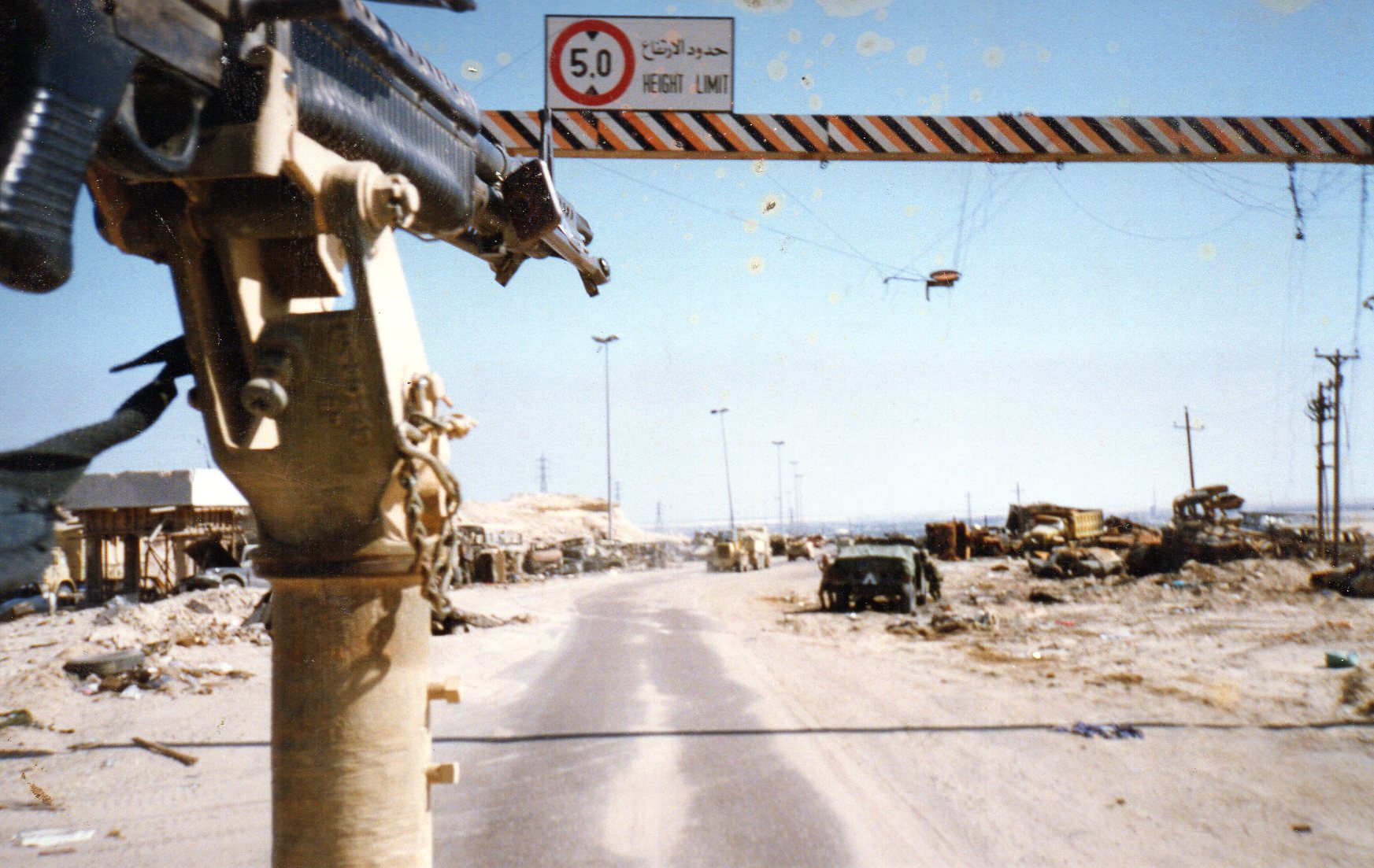
Much has been written about the so-called “Highway of Death.” The Iraqis were faced with taking on the American, Saudi, and Kuwait forces coming in to liberate the country. From the north, they risked being cut off by our forces sweeping through Iraq. It only made sense that they tried to get out. They were also trying to take as much combat power as they could with them.
Simply put, the Highway of Death was open season on several Iraqi heavy divisions. They were bombed and strafed till there was nothing left to bomb or strafe.
A lot of criticism has been waged that what we did was something we never should have been done. Critics have compared it to murder. That it was extremely one sided, I don’t disagree with that. But war isn’t about being fair or nice.
It’s about getting your butt home alive.
So, I don’t condemn it simply because if all that armor and manpower had gotten out, we’d have had to face them. That would have meant more casualties on our part. George Patton said it best, “You don’t win a war by dying for your country. You win a war by making the other poor bastard die for his.”
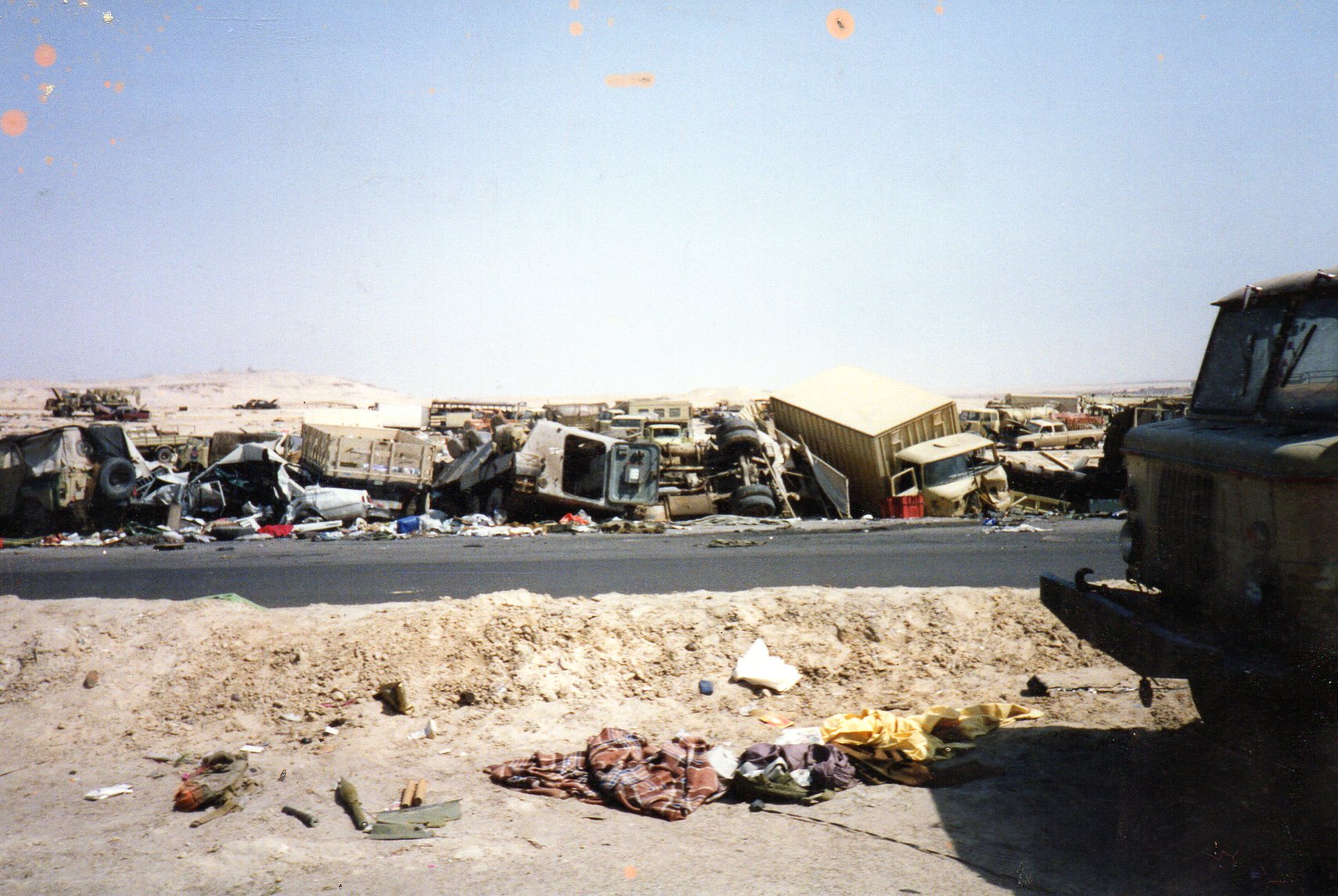
Even knowing that, I couldn’t help but feel pity for them. They were facing a modern air force. Without air cover of their own, the Iraqi tanks and vehicles were turned into one large scrap yard.
As we rolled through, I caught the sickly sage-honey smell of decaying flesh. Once you’ve smelt it a decomposing human body, you never forget it, and I know what one smells like. There were no bodies in the wreckage (I tend to believe that – I’m sure they’d been collected). And that a number of the Iraqi soldiers simply ran away into the desert (maybe so). But I know what dead human flesh that’s decaying smells like. Maybe it was just pieces, maybe just blood, but I know something was still in those wrecks.
A single lane road had been opened. In places, cars and trucks had been almost stacked on top of each other. it was like moving through a canyon of busted metal. At each end were units maintaining the traffic flow.
It was a relief to get out of it the junkyard.
As we cleared it, Kuwait City was directly ahead.
We’d do another detour in our recon.
AUTHOR NOTE: Years later would I take the Highway of Death passage and make it a key chapter in my first novel. In it, Will meets his cousin Nathan. Nathan doesn’t play much a part in the novels till much later. But his dad and his mom do.
All photographs Copyright – Richard L. Muniz
Discover more from William R. Ablan, Police Mysteries
Subscribe to get the latest posts sent to your email.
 William R. Ablan, Police Mysteries
That was quite the recon, William. I imagine everything had to be reported, at least in general.
LikeLike
Everything from potholes on up. then there was the really big one you’ll see in a couple of days.
LikeLiked by 1 person