
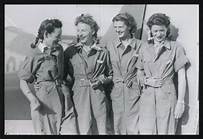
“What do you mean, I don’t get a uniform?” one exasperated pilot asked.
Jackie Cochran and Nancy Love both faced a pool of potential pilots and they must have felt the same exasperation.
“Ladies,” they said. “We’re not part of the military. We’re contractors.”
They read the disappointment on their faces but what could they do. It was a miracle they were letting women fly the machines to begin with.
Both Jackie and Nancy would have gone on with their respective speeches.
“You will have to provide your own food and lodging,” they explained. “You’ll have to use whatever shoes you wish. My advice is talk to your dad or brother. Let them help you find a pair of good boots. You’ll also need warm clothing. It’s get chilly up high.”
Nancy’s crew fared a little better. They were ready to fly. And they had an idea of what to expect.
By September of 1942, the WAFS were flying out the New Castle Army Airfield.
The trouble with flying –
Ferrying turned out to be interesting duty. One week you might be flying P-40s. Another B-25s or C-47s.
Nancy listed fifty different types of aircraft she’d flown. Nineteen of them were military. Oddly, the P-51 is missing from the list, though it’s known she flew it.
Ferrying duty also taught the women that they never knew what to expect at the airports they landed at.
“We landed for the night in the one small town in Iowa,” one pilot reported. “It was like the whole town turned out to see us land in those B-17s. They drove us into town and put us up in their homes. They made sure we had a good supper and breakfast.”
Others reported a less that warm welcome. “We were ferrying P-40s and landed at this strip in Kentucky. While they were refueling the planes, we went over to the snack bar to get something to eat.”
“And?” Nancy asked.
“They wouldn’t serve us because we weren’t wearing dresses.”
One of the pilots was of Asian descent. She found herself looking down the barrel of a gun. Everyone was positive she was Japanese and they were trying to attack using captured aircraft. The confusion only deepened when she removed her helmet to reveal she was a woman and she spoke perfect English. They felt this was exactly what “The sneaky Japs” would pull. Her fellow fliers had to intervene.
Another was Hispanic and looked it. She was denied entry to an establishment because of her ethnicity. The exact words she recalls, “We don’t serve Mexicans here!” One of her companions went in and got her food to eat. The women sat together outside on the tarmac next to American war machines. “If there was somewhere else to have bought food, we would have,” they later said.
“You never knew,” one pilot would say. “Sometimes we were heroes. Sometimes we were asked why we weren’t in the kitchen baking cakes.”

Jackie’s School –
While Nancy and her crew were ferrying, Jackie was looking to add numbers to the WAFs.
Jackie officially started her school in November of 1942 at the Houston Municipal Airport. Later, the school would move to Sweetwater, Texas. Almost all the students had some flight experience. But there’s a difference between a small plane and a B-17. Each had to be trained up on the various craft they’d be flying.

Interestingly, none of the girls were black. It wasn’t for a lack of applicants. There were several black women who were accomplished pilots and they applied. None were accepted. One applicant was told by Cochran that it’s tough enough facing the discrimination in this field by being a woman. She felt adding in the race factor would make life unbearable for a black lady pilot. She didn’t want to put them through it.
Makes you wonder how bad it was. If the Tuskegee airman had problems, what would it have been like for a black woman?
But that wasn’t the only problem the women face. Those reporting in for the school had to pay their own way. The best they were given for uniforms were overalls. The aircraft they trained in was enough to make them nervous.
“The airplanes we had for training was junk,” Jackie said. “They were hand-me-downs and were worn out when we got them. Not only did we have to learn to fly them, we had to learn to maintain them.”
The military was still the Good Old Boy machine.
And the girls felt it.
And then, a few months later, tragedy struck.

Download and Read “Grandpa’s War” for free by clicking on the picture. This book contains hundreds of photographs and remembrances of the author. The book is meant for personal use only and is subject to copyright restrictions.
Discover more from William R. Ablan, Police Mysteries
Subscribe to get the latest posts sent to your email.
 William R. Ablan, Police Mysteries
This history is amazing, William.
LikeLike
The more I study these girls, the more astonished I am by them.
LikeLiked by 1 person
Really enjoying this series.
LikeLiked by 1 person
Thanks. About four or five months ago, a friend and I went up to Cheyenne to see the B-29 teh CAF flies. They had a T-6 trainer also there, and i got into a conversation with the pilot. He told me that his mother had clown that very same plane during WW II. In addition to ferrying aircraft, she also trained other pilots. He was astonished when he turned ten to discover not everyone’s mother flew airplanes, much less fighters and bombers.
LikeLiked by 1 person
I can see how a kid would assume everyone had a family like their own. Thanks for the background.
LikeLike