
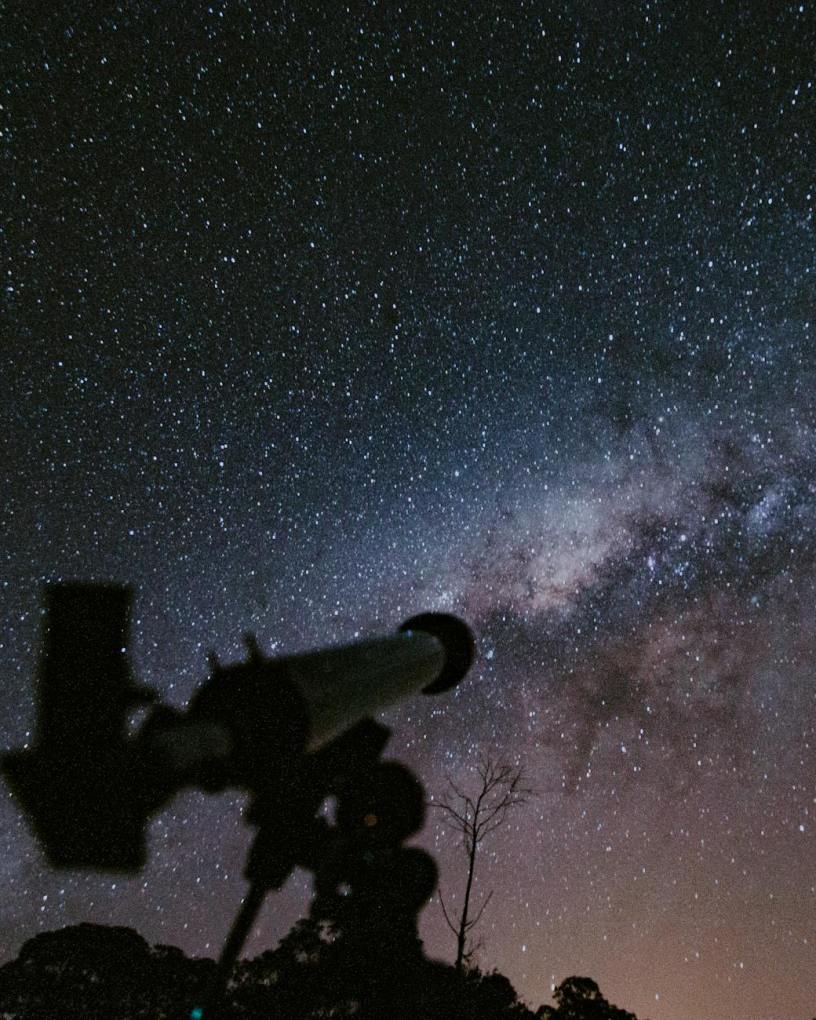
For about the last fifteen years, every night before we go to bed, I go outside with the puppies.
They run around and do their thing like dogs do while I stand in the backyard. And if it’s a clear night, I let my eyes go skyward. I trace the familiar lines of Orion and hunt down the ghostly Pleiades. I find Sirius, and then I move around the sky.
Recently, I’ve been enjoying to so called “Parade of the Planets.” There was Venus, dazzling as always. Bright enough to cast a shadow. And almost overhead was the next stop out after our Moon. Mars, rusty red and dazzling. And between them . . .
Nothing.
Jupiter is supposed to be there. The giant of the Solar System. The next biggest thing to the Sun. An astronomer said, that “The Solar System consists of the Sun, Jupiter, and assorted trash.” Kind of puts us in our place – doesn’t it.
But it’s gone.
I looked again. It was there last night. Not as bright as Venus, but certainly impossible to miss. Where did it go!

What happened to it? It could easily swallow 1300 Earths and have room left over. Had I been able to see Jupiter’s magnetic field, it would covered a fair chunk of the sky.
But Jupiter was gone. Something that was there last night. And the night before. And for billions of years before that. Now, it was just gone.
For an instant, the sheer incredibility of the idea stunned me. How does a planet go missing?
And then, ever so slowly, a star went from gone to dim, to dazzling white. Jupiter had returned.
Dummy, I thought. The sky was completely cloudless except for one little cloud. And it had managed to be blown right between me and the planet.
Talk about feeling stupid.
At least I didn’t feel too stupid. I was in good company.
On 20 Mar 2018, Astronomer Peter Dunsby was working at the observatory at the University of Cape Town. As I understand it, he always used a certain star to test his settings. So, he was familiar with the area in the eyepiece. But when he looked, bang in his field of view is this bright red star. That star wasn’t there a few days before.
Thinking he’d stumbled onto maybe a supernova; he posted a message on the Astronomers telegram. He described the bright star nestled between the Trifid and Lagoon Nebula’s, gave position and etc.
Around the world, astronomers moved telescopes, looked in their eyepieces and chuckled.
About forty minutes later, the Telegram issued this correction: “The object reported in ATel 11448 has been identified as Mars. Our sincere apologies for the earlier report and the inconvenience caused.”
Mars is a planet. The word planet means “Wanderer” in Greek. Why? Because if you watch the stars, you will see they move across the heavens. Not too many weeks ago, Mars was between two stars, forming a straight line (more or less). Its orbit (and ours) caused it to move so it’s no longer in line with them. Now, it forms a triangle with them.
What had happened was Mars had simply drifted into his field of view.
The scientific community has long been accused of not having a sense of humor. But in this case, it was proven it does have one. Part of the message read “For Discovery of Mars. Congratulations, Prof. Peter Dunsby!”
I bet he caught hell over that for a long time!
Discover more from William R. Ablan, Police Mysteries
Subscribe to get the latest posts sent to your email.
 William R. Ablan, Police Mysteries
I thought this would be about Pluto! We did enjoy the planet parade. Wow!
LikeLiked by 1 person