
At the intersection of 16th Street and 35th Avenue in Greeley, Colorado is a park. Now, you might be thinking that’s no big deal. Most cities have a park.
So true.
But this one is special. Located near that intersection is the Weld County Veterans Memorial and it’s “dedicated to the men and women of Weld County who have served our country in times of peace and war, and especially to those who gave their lives”.
Again, almost every city and county in America has one. And most have something associated with the military on display. Some have cannons, others have tanks. Some have old fighter jets watching over a list of names.
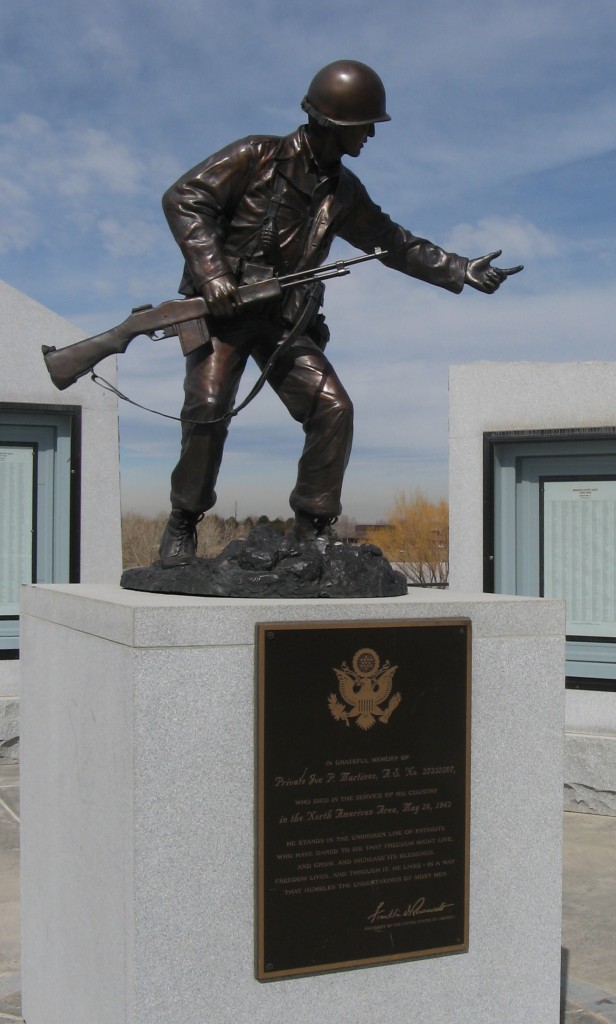
This one has a bronze of an American Infantryman cast by Maxine of Greeley, Colorado. The soldier clutches a BAR and is looking back slightly and seems to be motioning unknown legions of soldiers forward.
Again, this is a common thing to find at such places.
What isn’t common is who the statue is of. Reading the plaque, I see:
IN GRATEFUL MEMORY OF
Private Joe P. Martinez, A.S. No. 37332507,
WHO DIED IN THE SERVICE OF HIS COUNTRY
in the North American Area, May 26, 1943
HE STANDS IN THE UNBROKEN LINE OF PATRIOTS
WHO HAVE DARED TO DIE THAT FREEDOM MIGHT LIVE,
AND GROW, AND INCREASE ITS BLESSINGS.
FREEDOM LIVES, AND THROUGH IT HE LIVES – IN A WAY
THAT HUMBLES THE UNDERSTANDINGS OF MOST MEN
Franklin D. Roosevelt
PRESIDENT OF THE UNITED STATES OF AMERICA
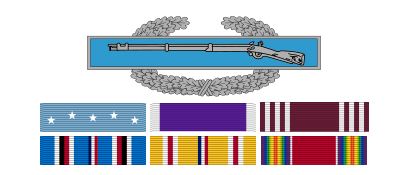
Private Martinez won the Congressional Medal of Honor (CMH) and to date is the only soldier from Weld County to have done so.
The Plaque says he died in the North American Area on 26 May 1943.
North American Area? Even as a student well versed in WW II, that makes me stop and wonder where the heck this could have happened. Then I remembered a collection of rocks in the North Pacific, the tips really of underwater mountains that form a curtain across the water that separates the United States from Japan. It’s a finger pointing almost right at the heart of Japan.
Or a dagger as some think the Japanese might have thought.
Some historians believe that the Aleutian campaign was a feint on the part of Japan, an attempt to draw American Forces away from the impending attack on Midway. Others believe it was an attempt by Japan to simply build up their defensive parameter and to either deny potential bases to the Americans or make it more difficult to link up with the Russians.
Of course, the islands were American property and there was some national pride involved when Japan invaded them. But there was also fear that the islands could be used as bases against us, and it was important to ensure that didn’t happen.
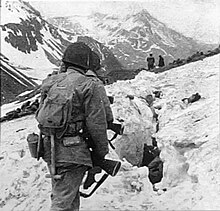
Whatever the reason, it was as brutal a place to fight a war in as you can imagine. Both sides of the equation had to deal with devastating cold. There are accounts of oil in trucks and aircraft freezing solid. Roads were non-existents and supplies often times were carried on the backs of men across ice cold tundra and through snow-filled passes.
It was a preview of things we’d see in Korea several years later. Ill equipped for this action, American servicemen froze in defensive positions. With difficulty, they pushed the Japanese off the islands.
But this story is about one man at that battle.
Joe Martinez was born on 27 Jul 20 in Taos, New Mexico. There was some agriculture in the area and artists had discovered the serenity and beauty of the town. But there wasn’t enough to force someone to stay. Looking for a place that would be easier to find employment and better for his family, the elder Martinez made the decision to move his family to Ault, Colorado, a small town less than ten miles north of Greeley.
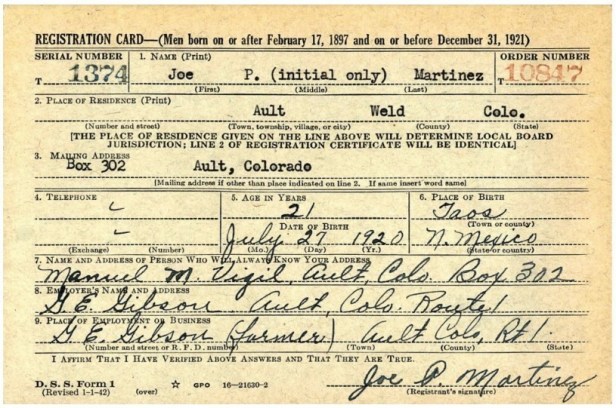
Being the son of an agriculture worker, it’s a given that Joe Martinez was no stranger to hard worker. I know as a child what working the family farm was like. But he was doing it for pay and well before some of the current labor laws would have stopped it. What he was doing wasn’t uncommon among young people then as they picked potatoes, corn, or did any of the work we normally associate with adults doing.
It was in August of 42 that Joe was drafted into the Army and was sent to Camp Robert, California for basic training. Within months, he found himself assigned to the 7th Infantry division.
On 11 May 43, the 7th Infantry Division conducted a landing at Holtz Bay, Attu. This began the Battle of Attu. The battle would be over at months end with some of the bloodiest hand to hand combat seen up to that point. The battle would have the dubious distinction of being the only battle where US Forces fought the Japanese in the snow.
Pvt. Joe Martinez wouldn’t be there to see the end of it.
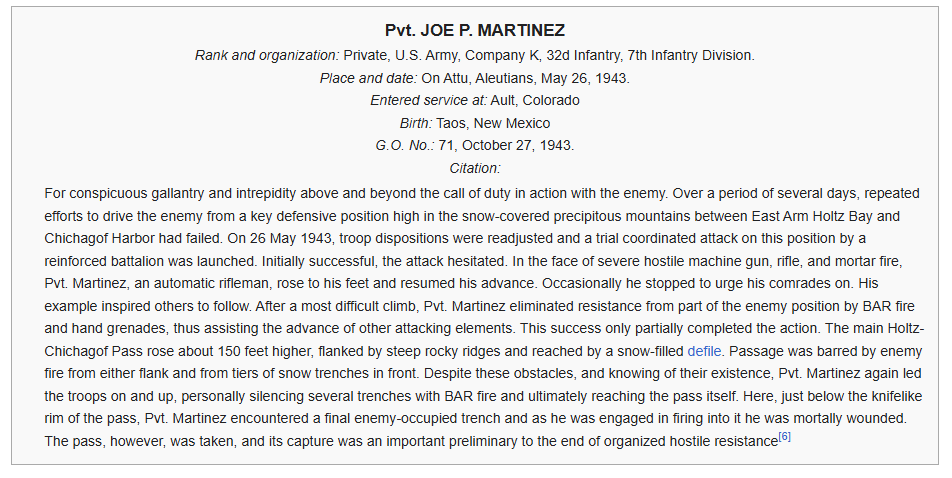
On 25 May, he and his regiment were pinned down by heavy machine gun fire. Martinez began firing his BAR into Japanese positions and then led two separate assaults to overwhelm the Japanese. While attempting to neutralize a final foxhole, Pvt Martinez was shot in the head.
He passed the following day.
Pvt. Joe Martinez was the first Spanish-American soldier to receive the CMH posthumously for combat on American soil. The citation says it all.
His Citation
The entire Battle for the Aleutians would be called “America’s forgotten Battle” since it would be overshadowed by events such as Midway, Guadalcanal, and Iwo Jima. Some history books don’t even note it except in passing if at all.
Pvt. Joe Martinez was buried with full military honors at the Ault Cemetery in Ault, Colorado.
In November of 1943, General Frank Culen who witnessed Pvt. Martinez’s actions and put him in for the medal, presented the Congressional Medal of Honor to Joe’s father. I can imagine it was a rather emotional time for everyone involved and I’m sure the General told them about seeing his son shot.
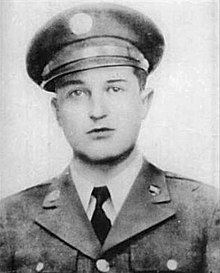
And so ends the official record of a hometown boy that went to war. He and I had a lot in common and when I look at his picture, I wonder who he was. What was his favorite food? How about music? Did he listen to the exploits of Buck Rogers over the radio? Too bad I missed him. I think we could have been friends.
There have been numerous buildings named for him by the Army, the VA, and the Colorado State Government. Additionally, there’s a park in Denver Colorado and a stretch of highway named in his honor. There was also a troop ship (the U.S.N.S. Pvt Joe P. Martinez} named for him.
Today, his grave is marked as a CMH winner in Ault. Not far away is a marker honoring this hometown hero. And every time I pass it; I have to wonder if anyone even thinks about what he did or knows what the statue is all about.
Presentation of CMH- https://www.coloradohistoricnewspapers.org/?a=d&d=SKZ19431119.2.11
Article announcing Pvt. Joe Martinez would receive the CMH – https://www.coloradohistoricnewspapers.org/?a=d&d=CEC19431208-01.2.45
The Pvt. Joe Martinez memorial – https://www.hmdb.org/m.asp?m=250042
Discover more from William R. Ablan, Police Mysteries
Subscribe to get the latest posts sent to your email.
 William R. Ablan, Police Mysteries
A real hero. Thank you for introducing him to us.
LikeLike
I’d driven past the monument dozens of times without wondering who it was. I finally found out.
LikeLiked by 1 person
It is great to see such a post about the ATO, so many knew nothing about it, nor do they remember.
Thank you, Richard!
LikeLike
My father had tons of books on WW II and there were several on the battle. But I first came to know about the battle as a kid through a model of a P40 in Aleutian Tiger paint. That prompted me to learn about it. That battle still astonishes me, and it’s like you said, a lot of folks know nothing about it or if it even happened.
LikeLiked by 1 person