
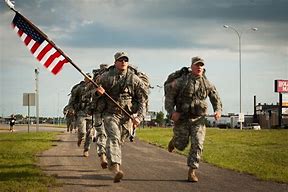
When a Command Sgt. Major asks you to do something (notice the word “Asks” not orders), you still say, “Yes, Sgt. Major. I’d love to do it.”
In this case, it was a combat marathon to raise money for March of Dimes, a charity that our Sgt. Major believed in. He’d gone to the three MP companies that made up the 716th MP BN at Ft. Riley and asked around for the best runners. Everyone knew I ran a lot. I was living on post at the time in the Custer Hill housing area with my family. I was a familiar site running into the company area at Main Post early in the morning, And it wasn’t unusual for me to go for a run instead of eating lunch, and then I often ran home in the evening.
Since everyone knew I ran, it was a natural I was tapped for the marathon. I didn’t expect to have any trouble. I was due to start PLDC (Primary Leadership Development Course – Sergeants School as it’s sometimes called) the following Monday, and this would just be a psychological push for me for that course.
The run was set for a Saturday, and there were a dozen of us who would be doing it. There was an oval running track at Camp Funston that we’d be using and all we had to do was show up for it.
It was October, and so heat wasn’t much of a problem, but chairs, cots, and overhead cover were set up for us.
Now, when I mention the word marathon, the first image that get’s conjured up is several men and women in shorts and t-shirts and running shoes doing some twenty-six plus miles.
In our case, the only thing that image had in common with a normal marathon was we were allowed to wear running shoes. We were to run in combat BDUs. That included LBE (Load Bearing Equipment), a full canteen, and a holster with a fake 45 in it. Instead of a helmet, we could wear a soft cap. Oh, did I forget to mention a pack that weighed in at 65 pounds and the M-16 we’d be carrying?
Also, this was less a marathon and more a relay marathon. While the idea was everyone would run the required mileage, each MP would run three miles, hand off the weapon and rest till the relay cycled around back to him or her. I was about to find out it’s easier to run a full marathon than do a stop and go one.
We all showed up at 5 that morning to begin. We’d done some math and figured if we each ran the three miles in around 15 to 20 minutes, it would be over two hours before it cycled back around to each of us. This sounded great, but it made for a long day.
“Who wants to go first,” Sgt. Major asked. We’d already stretched out, and warmed up and were ready to go.
What the heck, I thought. “I’ll go first.”
He nodded and put my name at the top of the list. Quickly he filled in the rest of the names.
“Okay. This is a quarter-mile track,” he said. “Twelve times around is three miles.”
I double checked my shoes, my straps, and then walked over to the starting line.
“Whenever you’re ready,” Sgt. Major said.
“Here we go,” I said to myself. I took the first step of what was destined to be a lot of steps that day.
After about five steps, I decided I hated running in a circle. but I’d committed, and I was going to finish what I’d signed up for. About twenty minutes later, I finished my first three miles. The second runner was ready, and as I came up, he started running. I handed the M-16 off to him, and then walked around a little to cool down.
“Rest when you can,” Sgt. Major said.
“Will do,” I said. I dropped my ruck, and sat down on one of the cots. By my calculations, I had another two hours before running my next three miles.
Doughnuts and coffee were brought out by Captain Price and the First Sgt. I ate, and then lay back on the cot and rested.
It hadn’t occured to me that I was making a huge mistake. I’d ran several marathons, and everyone knew I was a distance runner. I could keep mile after mile going and that was with a ruck sack.
I’d even broken a foot during one marathon. I hadn’t realized what had happened at the time, and finished the run. Only afterwards did I notice the foot was a little sore. I took a few days off, and then went right back to my grueling training. It wasn’t until almost a month and half later that I realized it was broken.
But the mistake I was making was in two parts. First, I trained on roads, not a cinder track. Second, I ran straight through. There was no run three miles and then stop and then run another three, repeat. i hadn’t expected it to be so hard on the body.
I knew something was run about the fifth set in. My shins were feeling like someone had kicked me with cleats. Each step brought shooting pains through my shins. Shin splits, I thought. I finished my three miles and the next runner took over, I stretched out a little, feeling tired, but the pain in my legs was starting to make walking difficult.
I went over and sat down. A lot of the guys and girls were rubbing their lower legs, especially around the shins.
“How you guys doing?” I asked.
“Fine, fine,” was the answer.
Right. I knew we were all in the same boat. Like me, they were used to running on the roads. The cinder track wasn’t helping us. Each one of my fellow MPs had shin splints.
I opened a pocket on my ruck and pulled out a bottle of Bayer aspirin.
“If you guys need it,” I said, holding up the bottle and shaking it. I took a couple, and put my ruck on the cot. I used it to put my legs on top of and tried to ignore the pain.
The sixth, seventh, and eight turn came and went. But now I felt like someone had hit me in the shins with a hammer. On the last break, I took off my shoes, rolled up my pants, and ran my hands over my shins. I could feel the small balls caused by tendon damage.
And all I could think of was that I was starting PLDC on Monday. Painful shin splints could cause me to have to bow out. If that happened, my slot would go to someone else, and then I’d have to wait. That would delay going to the promotion board and bringing in a little more money.
“Muniz, you okay?” Sgt. Major asked.
“Functioning perfectly, Sgt. Major,” I answered. Like hell I was going to miss the chance to knock out PLDC. I’d just tough it out.
I lay back, closed my eyes, and read a book in my head. Anything to keep from thinking of the pain.
Flag call came and went, and we all stood, facing the flag and saluting it.
I lay down again, and managed to catch a quick nap. When I woke up, the sky was dark. The lights on the track had been turned on, and their brilliance washed out the heavens. Only the brightest stars shone through.
“Last run,” Sgt. Major said.
I double checked my boots, hook of the sleep and stretched out a little. On the far side of the track, one of the MPs chugged through his lap.
Here he comes, I thought. As he got closer, I started running, needle like pain exploded in my shins. I ignored then, reached out and took the weapon from him.
“Good luck, Rich,” he yelled.
“This is it,” I yelled back. “one more for each of us, and we’re done.”
A lot of us who are runners know that the last little bit is often the hardest. You’re so close, you can see that finish line. You can almost taste crossing it. And yet, like some bizarre twist of time and space, it seems to get further and further away. You’ve come so far, and all you want to do is quit, but you won’t. You start playing every card you can to keep going.
One lap down. Two more.
I sang cadence to keep moving. “C-130 rolling down the strip. Airborne Daddy on a one way trip. Mission undetermined, destination unknown. Don’t even know if we’ll be coming home . . .“
One and a half laps to go. “Stand up, hook up, shuffle to the door. Jump right out on the count of four . . .“
The pain in the shins was getting harder and harder to ignore.
One lap left. “. . .Pain! In my legs. Pain! In my chest! Pain! In my side!“
Wrong cadence to be singing.
“No Pain. No Pain. No Pain.” The words were less cadence, and more a mantra.
“One . . . Two . . . Three . . . Four! We do this every day . . .“
One of my friends was running alongside me. I handed of the weapon to him. And then kept running alongside him. We were both singing cadence at the top or our lungs, our voices echoing in the evening air.
We finished his first lap. “You got this,” I shouted.
“Thanks!” And he was rounding the turn on his second lap.
I ignored the urge to limp. Neither leg hurt less than the other, so it made little sense to do so.
“Almost twenty eight miles,” Sgt. Major said. “That’s five hundred dollars for Jerry’s Kids. Well done!”
“Thank you, Sgt. Major.”
I stayed and cheered others on. Many of the younger MPs, not wanting to be outdone by the old dog either matched or surpassed by mileage.
When we finally wrapped up around 2230, we are all incredibly tired. I went home, rubbed liniment on my legs, and tried to sleep.
That Monday, I reported to PLDC. I ate aspirin as if the little white tablets were M&Ms for several days, but I made it through. By the end of week two, I’d healed up enough so I didn’t worry about the pain anymore.
I graduated PLDC in the top five percent.
And anytime anyone asked me to push the envelope, I always did. That included a little nature hike called the International Four Days March at Nijmegen.
But that’s another story for another time.
NOTE FROM THE AUTHOR: Like my blog and stories? Check out my novels available on Amazon. I have two out right now, The Cross and the Badge, and Against Flesh and Blood. A third novel, Event Horizon will be coming out soon. Click on the novel names to be taken straight to them.
Discover more from William R. Ablan, Police Mysteries
Subscribe to get the latest posts sent to your email.
 William R. Ablan, Police Mysteries
About how old were you then?
LikeLike
Thirty one or thirty two at the time. The next nearest guy to me in age was twenty two.
LikeLiked by 1 person
Pushing through pain is a good lesson to learn early in life. Well done!
LikeLiked by 1 person
Nor arguments here.
LikeLiked by 1 person