

The cross on the hill for the New Cover of Book One of the Lawman series: The Cross and the Badge, actually exists. I couldn’t think of a better cover for the book when I redesigned it. So here it is.
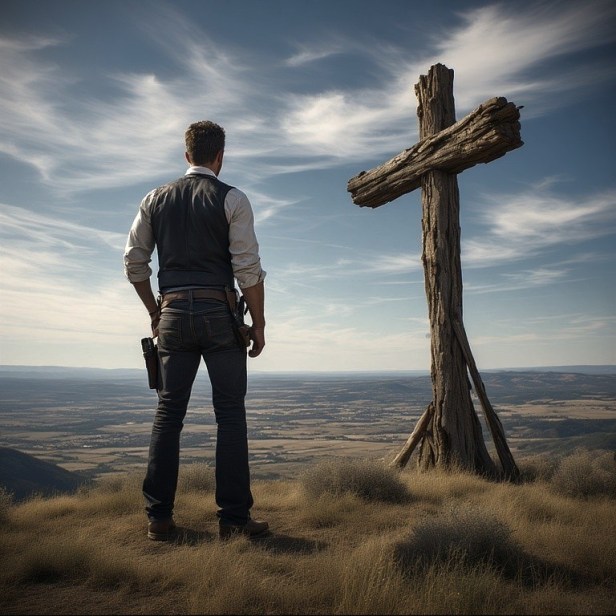
But I’m making a few additions to the books.
One, is the story of some feature used in the stories (Conejos County and the San Luis Valley does exist).
The other is discussion questions of other resource in the back of each book.
So, that’s where we’re headed.
In the meantime, Here’s the story of the cross on the Hill.
If you’re ever going through the San Luis Valley, and you’re on Highway 17 heading west into New Mexico, you come to the charming village of Mogote. It’s a rambling settlement with the Conejos River running through it, cottonwoods, and small shops, homes, and fields.
As the road dogs around and it clears a patch of cottonwoods, you look at a hill with a cliff face. And as you get closer to you, you’ll notice an unassuming, manmade structure on top of the hill.
It’s a simple cross. It wouldn’t look out of place on top of a church, but the hill overlooking the small valley isn’t a church.
I remember having seen it long ago as a child. I’d be going with my father up into the summer range to deliver supplies to the sheepherder. Seeing a large cross on a hill is an attention-getter. I remember asking about it, and the answer was that a man had been struck by lightning on top of the mountain. The cross marks where he died.
That wasn’t the correct answer.
Others speculated it was a leftover from the Penitentes religion from the old days when the area was first colonized.
Also, the wrong answer.
Others say a man killed himself up there.
Again, incorrect.
The correct answer goes back to 1912.
Part of the reason for it is the geography of the area. Mogote sits right at the bottom of Conejos Canyon. The canyon forms a natural chimney of sorts, and warmer air from the valley floor can move up it and be channeled so that it helps in creating thunderheads.
Now, if you live in Kansas, you know all about thunderheads. Every time one forms, people look at them nervously. These things can generate tornadoes. But more often than not, it’s hailstorms. We’re talking about the storms that deliver fist-sized pieces of ice, and level crops, damage homes, and kill livestock.
In 1911, the farmers who lived near the mouth of the canyon were on the receiving end of a hailstorm that can only be described as “Epic.”
Some accounts included the word “Demonic.”
When it was over, the crops in the fields were destroyed. When you’re a farmer who relies on your crops to pay the bills, feed the family, and just survive, and they’ve just been wiped out, then you’ve got a big problem.
The following year, and after some serious praying, Carlos Martinez took out the ultimate insurance policy. He and others took lumber and cement to the top of the hill. There they erected the cross on the hill.
Since the day the cross was erected, there has been no hail damage to the crops. In the small village.
The cross has a personal touchstone for me.
Some might know that I went into the U.S. Army as an old man (age 29–damn near tripped over my cane on the 12 Mile Road march). I spent several months getting back in shape after enlisting. If the old dog intended to hang with pups, he needed to be as strong as a pup.
We’re talking weightlifting, push-ups, sit-ups, climbing, and lots of running. I’d once been very athletic, but years of letting exercise slide, smoking, and not eating right had taken a toll on me.
Don’t believe me?
I’ve got a picture of me at 27, and I look like Elvis before he died.
I know. I know. The King isn’t dead. He just went home.
Now, I had to get it back.
My test to ensure I was ready for Basic was to climb the hill up to the cross.
I was due to report to Fort McClellan, Alabama, on the 21st of February.
On January 31st, I climbed the hill.
The area is wild, rocky and damn near vertical. Doing it in the summer means a few snakes around. I didn’t care to run into one, and doing the run in winter avoided a close encounter of the worst kind with them.
I ran along a game trail made by deer and assorted other wild animals, and within ten minutes I’d reached the top. I stood at the top, next to the cross on the windswept hill. I admired the view.
I thanked God that I was ready.
Today, over a hundred years after it was erected, the cross still stands guard over the fields and homes of the people who live in the area. Look for it if you’re ever in the area.
Special Thanks to Robert Ruybalid and his excellent Facebook site “Forgotten Southern Colorado” for the story of the cross and the picture.
Discover more from William R. Ablan, Police Mysteries
Subscribe to get the latest posts sent to your email.
 William R. Ablan, Police Mysteries