


This is a story I’ve told before. But the lesson learned is one wroth repeating.
So, here goes.
There are things you never forget.
Things like the first time you meet the person you’ll spend the rest of your days with.
Or when your first child is born.
Or a night when a thousand men and then some are killed.
We’d been in Iraq as part of the coalition forces in Operation Desert Storm for not quite forty-eight hours.
We’d set up our perimeter that night. As darkness goes, it was a darkness that wraps around you like a cloak. It seemed to swallow up almost every scrap of light. I could see the rest of the platoon, the vehicle I was in and most of the convoy we were in.
But it still seemed dark.
Maybe it felt darker because we knew that in a few minutes, a light show of destruction would split the night. Things were being set up for a massive MLRS (Multiple Launch Rocket System) strike against Iraqi positions.
We watched and waited. In a way, it was almost like waiting for a rock show to start. We talked, drank our water, and chewed on chocolate bars.
And then the show started.
It was like lightning.
The first rocket ignited and exploded out of the launch tube with a boom that hit you in the chest. As the rockets launched, it was as if lightning had struck. In that flash of white light, I could see the launch vehicles, the desert, and other convoys for miles around. Afterimages danced in my eyes.
. The rockets arced up and away. One second, they were balls of fire racing up from the desert, and the next they were tiny dots of bright light aiming for something beyond the horizon.
When the sun came up, our convoy drove in the direction the rockets had followed.
Several hours later, we reached where I assumed the rockets had fallen.
We were on a small ridge looking down into a valley.
The convoy stopped.
Scattered throughout the small valley were the remains of several dozen tanks, armored personnel carriers, and trucks. Most of them were burning. Others were just so many busted parts. I’ve seen scenes in war movies that were supposed to represent something like this.
Hollywood just can’t capture the reality of a battlefield.
Even words like “devastating” and “apocalyptic” are too small to describe this. I’ve finally decided there are no words for the battlefield.
We stood outside our vehicles. There was no joy here. No comments like “We really kicked their ass” to be heard. I remember a statement that goes the difference between murder and war was whether you needed an accountant to keep track of the dead.
When I’d first heard the statement, I’d thought it was funny.
This wasn’t funny.
This was nothing less than murder on an epic scale.
The smoke from burning rubber and fuel hung over the battlefield, burning the nostrils and making the eyes water. And mixed in with the smell of burning fuel was a sweet odor like burnt sugar.
I’d smelled it before. As a sheriff’s deputy, I had gone into a burnt house to help recover a body. We found him. He didn’t look human. The body had drawn up into a fetal position and looked more like a roasted turkey than human.
Once you smell it, you’ll never forget it.
In the wrecks of the tanks and trucks, flames were consuming the bodies of our enemies. Trucks were overturned or burnt-out shells themselves. I’m sure the drivers were still in them.
What spread before us had been part of the proud Republican Guard. They called themselves the Lions of Babylon.
The MLRS strike had slaughtered them like lambs hit by a pack of wolves.
“Hey!” someone shouted. “There’s someone down there!”
A soldier was pointing. I brought my binoculars up. Sure enough, walking along a roadway through the maze of twisted metal and smoking debris, was a single man. He had his hands in his pockets and his head was down. He looked less an enemy soldier and more like an old man walking through a park on a wintry day.
“Muniz. Bradley!” A shout came from our lieutenant. “Go down with the medics. Bring that man back.”
“Yes, sir,” I responded. Several medics with a stretcher and medical gear rushed over and got in our HUMVEEs with us.
“I’ve got over-watch!” Greg yelled at me.
I held up a thumb. What Greg meant was we’d take point, and he’d ride shotgun about ten meters back. They’d provide cover for us if anything went wrong.
We drove down the hill towards the battlefield. I had my rifle ready and glanced up at my gunner. He was scanning for anything else moving, his weapon moving back and forth. My driver was careful as he weaved around pieces of metal that could have given us a flat or put a hole in an oil pan or gas tank. Of course, there was the ever-present threat of unexploded ordnance to watch for.
Slowly, we drove towards the Iraqi.
He seemed oblivious to our presence as we closed in on him. He just kept moving on as if we didn’t exist.
We stopped, and I got out. We were maybe ten meters away from the shuffling man. He still hadn’t reacted to us. The medics got out and stood watching as the man moved painfully through the smoldering battlefield.
“Hey!” a medic shouted at the man.
He stopped, slowly turned, saw us, and stood for a while as if he was trying to think. Then, with a blank look on his face, he walked towards us. His hands were still in his pockets. His head and face was covered in blood. He had a head injury and that explained his confusion.
I don’t think it registered with him that we were American soldiers. I looked at his bloody vacant face and I didn’t see a hint of a tough enemy soldier in him. He was a hurt person needing help.
As he approached, his knees gave way, and he collapsed in front of us.
The medics rushed forward.
He was out cold.
The medics began assessing him. I stood near them with my rifle, watching the perimeter. It wouldn’t do to have another Iraqi soldier out here that was slightly more online than this guy. Maybe one with a rifle. He could take out a couple of us quickly.
I suspect he was the only survivor of this incident. I wondered what he’d think in the years to come. Would he consider himself lucky or wish he’d perished with his friends and comrades?
As the medics worked, I heard something.
I looked around. What was that?
I listened and heard it again.
It was a faint musical sound.
Maybe there was a radio in a truck, and it’s still picking up some music.
I listened some more.
It sounded more like an alarm on a wristwatch, one that hadn’t been busted in the battle.
I listened carefully to the music. It seemed familiar. Then, with a smile, I realized what was making it.
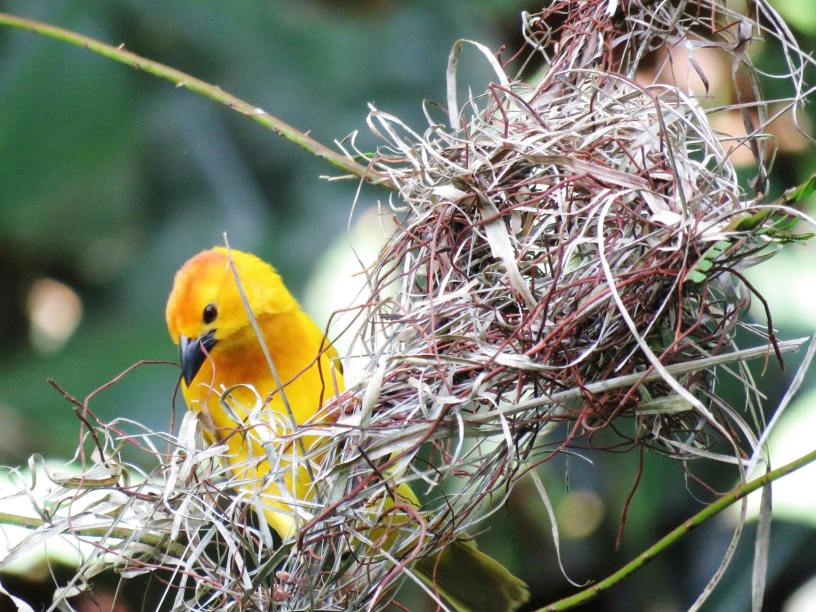
In the dawn and in the middle of hell, a small bird was singing.
Walking slowly, I moved towards the sound. I found it came from between two blasted vehicles. On a burnt and blasted battlefield, a small bush was standing erect. In it was a small nest. And in the nest, a small bird sat.
I looked at the bird and listened to its cheerful song.
I wondered what terrors it had gone through the night before. While tanks exploded, and hell rained from the skies, it had sat on its nest. It did its very best to protect its unborn chicks.
But now the fight was over and had moved on. All that remained was the carnage of the battle.
And the little bird, its nest, and eggs.
It had survived.
With the rising of the sun, it was singing a song of sheer joy at being alive.
All was right with its world.
The medics had the wounded Iraqi on the stretcher and were carrying him over to our HUMVEEs. I moved back, keeping my eyes open, and we went back to the rest of the convoy. A MASH chopper was called in to pick up the wounded man.
I heard he made it.
And on a burning battlefield, I learned a lesson for life from a small bird.
After a night in Hell, it sang for joy at dawn.
And so should we.
All photographs Copyright – Richard L. Muniz
Discover more from William R. Ablan, Police Mysteries
Subscribe to get the latest posts sent to your email.
 William R. Ablan, Police Mysteries
Nice that the bird and its nest survived and sang to you.
LikeLike
It taught me bad times don’t last. And at that moment in history, I needed the lesson.
LikeLiked by 1 person