
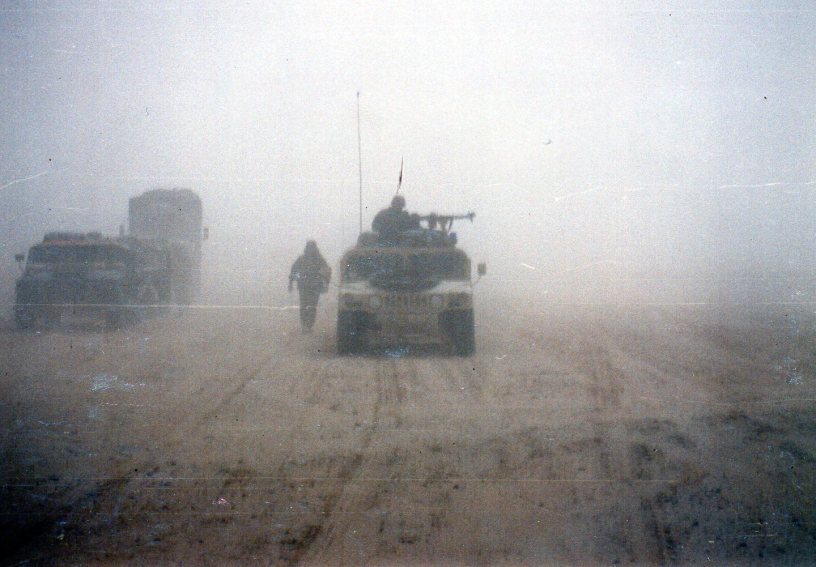

As I mentioned, being in a combat zone and moving is very good training for a career in the circus. When the word came, we were ready. Everything was packed and ready. All we had to do was drop the tents and load them up.
A slight wind began. It stirred up the dust forming a cloud that helped hide out departure. I always through that was rather nice. But like a large snake uncoiling, the battle central headed out. So, it formed into lines with us (The MPs) riding on the outside of the formation. Closer in were the M1s and assorted other tracks. Then the multitude of trucks and with the trucks that made up the TOC riding in the middle.
Looking at it, I realized that had this been a naval task force, we were the destroyers. We’d have been riding on the outskirts of the Task Force looking for the enemy. If the destroyers were the greyhounds of the sea, we were the wolves of the desert.
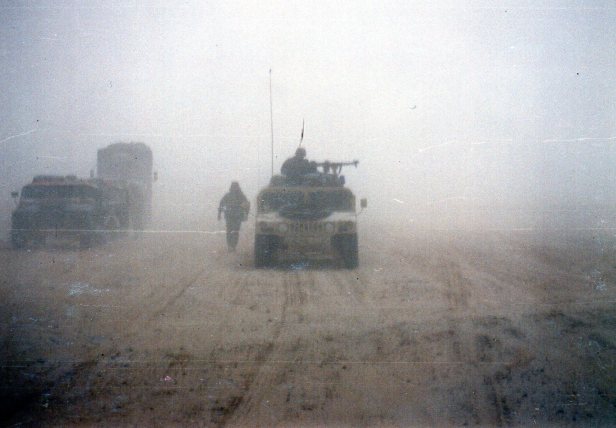
But like the destroyers that guarded the carriers of WW II, that meant we were expendable. If we ran into anyone, we’d have to both engage and slow them down and warn everyone else.
I’d done that in field exercises with 1st MPs. As we drove, I remembered an FTX (Field Training Exercise) that couldn’t have gone more wrong. Somehow, we won that engagement.
A lot of soldiers hated the field. But then they weren’t 1st Platoon, 1st MPs. A somewhat derisive term for MPs is Mud Puppies. We loved going out there, getting the HUMVEEs dirty and generally just having a great time.
I was new to the field. I’d been in the Army almost four years. Aside from time out in Basic, AIT, and PLDC, I had almost zero experience out there in the field. I’d had enough of working MPI. One day I walked across the street to talk to my friend Captain Scott Price. “Scott,” I said. “I’m starting to get some rank on my collar, but line time is something I need. If I can, I’d like to come to work for you.”
He and the 1st Sgt. walked over to the Battalion Headquarters and asked for me.
Two months later, we were getting ready to take 1st Platoon out to the National Training Center at Ft. Irwin, California. Ft. Irwin is about a close as you’re going to get to war without actually having a declaration of war. You go out there into the middle of the Death Valley, and you throw down with the local varsity team. We call them the OPFOR (Opposing Forces). They strutted around in Russian uniforms. They used tanks and equipment that had performance characteristics very much like Russian equipment. They even used Soviet doctrine in their battles. They were some serious players.
Having your butt handed to you by them was to be expected. These guys were so good, Patton and Rommel would have had their hands full trying to beat them. Indeed, almost no one beats them first time out.
Of course no one wants to lose to them, either. So we’d been out with brigade training alongside them in the vast training regions of Ft. Riley, Kansas. We’d be doing a lot of the same things we’d do out at NTC. But the idea is, do it here first. If you’re going to make a mistake, make it here first.
We’d gone out the month before for a week long training scenario, but that was just the entire MP company. This would be the first time I worked closely with tanks and other units. We would be preforming our real-world combat mission. I knew the books. I knew the drills. But I was going to rely heavily on my people to school me in what to do out there.
I was a fast learner. I enjoyed being out there since I knew all these guys. While in MPI, I’d worked closely with all of them when 1st Platoon was working garrison. They all knew I was former cop and I took every chance to pass on lessons learned.
Now, that was reversed. While in charge, I was also the student. I was learning to do the things they never taught in MP school, like how to put up cameo netting. And I learned how to load a HUMVEE so you had the maximum amount of space.
And being that amateur in the bunch, I also became a bit innovative. We’d developed a tactic for dealing with armor and ambushes. In it, if we need an AT-4, I’d hand it up to our gunner. He’d find his target, and when ready, would tell the driver to stop. We’d scream to a stop, he’d lock onto this target. Then he’d fire, and we’d get moving (the AT-4 is fire and forget weapon). We’d tried it in practice and it seemed to work. We were looking forward to trying it out on Ft. Riley’s home grown OpFor.
In this case, our Opfor was provided by one of our Calvary regiments and another infantry Battalion. They loved sneaking in, shooting up the place, and sneaking out. It was totally annoying.
Along about the middle of week two, we had an interesting training scenario. Word was that scouts had sighted a company sized element of armor headed our way. The plan for the defense was one I didn’t care for. What the LT did was to give each team a map that he’d marked with several different locations. Each of us was given a location where we were to head to and set up an observation post. We were to watch for the enemy and then send warning back. From these static positions, we were to engage and defend.
My Friend, Sgt. Richard Kelley didn’t like the plan either. Having come over from Armor to the MPs, he knew that the best defense against armor was movement. A static position would be quickly annihilated. Our LT was new, and I think our Platoon Daddy had cautioned him that wouldn’t work. But he’d made up his mind.
What I didn’t realize (until we were in the thick of things) was that my map had been mismarked. We were proceeding to the point assigned to us, and I’m looking at it thinking this doesn’t make sense. There was a highway that separated the two maneuver fields. All the other teams were to the west of the highway, and I was the only unit to the east. Between us was enough space to drive an attack through without being seen. In a real war, the highway wouldn’t have mattered. But there was no driving a tank across the highway here (it was a civilian highway) and this wasn’t real. We had to use ab underpasses that allowed us to go from one side to the other.
The underpasses formed a natural bottleneck and that would come in handy.
So, I’m looking at the map trying to figure this out. I had to be wrong I thought.
All of a sudden my gunner yells, “Tanks, left!”
“What?” I cried.
“Tanks!” he said again, pumping his finger towards the crest of a small hill.
I looked. It was OpFor armor, and we’d run right into it. M-113s were in an attack line headed hell bent right at us.
“Get us out of here!” I yelled at my driver.
He spun the HUMVEE around and gunned it in the direction we’d just come. I grabbed for the radio handset to report in. As I was doing that, a voice came over the radio. It advised me that if I were east of a certain location then I was wrong.
He meant us.I replied, “Tell me about it. We’re being chased by OpFor armor. Copy Sitrep.”
“Go ahead,” the radio said.
“Fourteen!” my gunner shouted down. “I count fourteen M-113s!”
I radioed where we were, our heading, the number of enemy vehicles, and what they were closing rapidly on the TOC.
We knew our only chance of not being declared administratively dead was to beat them back. We had to hook up with the rest of our team and fight them together. I pulled the AT-4 up and a satchel of simulated rounds.
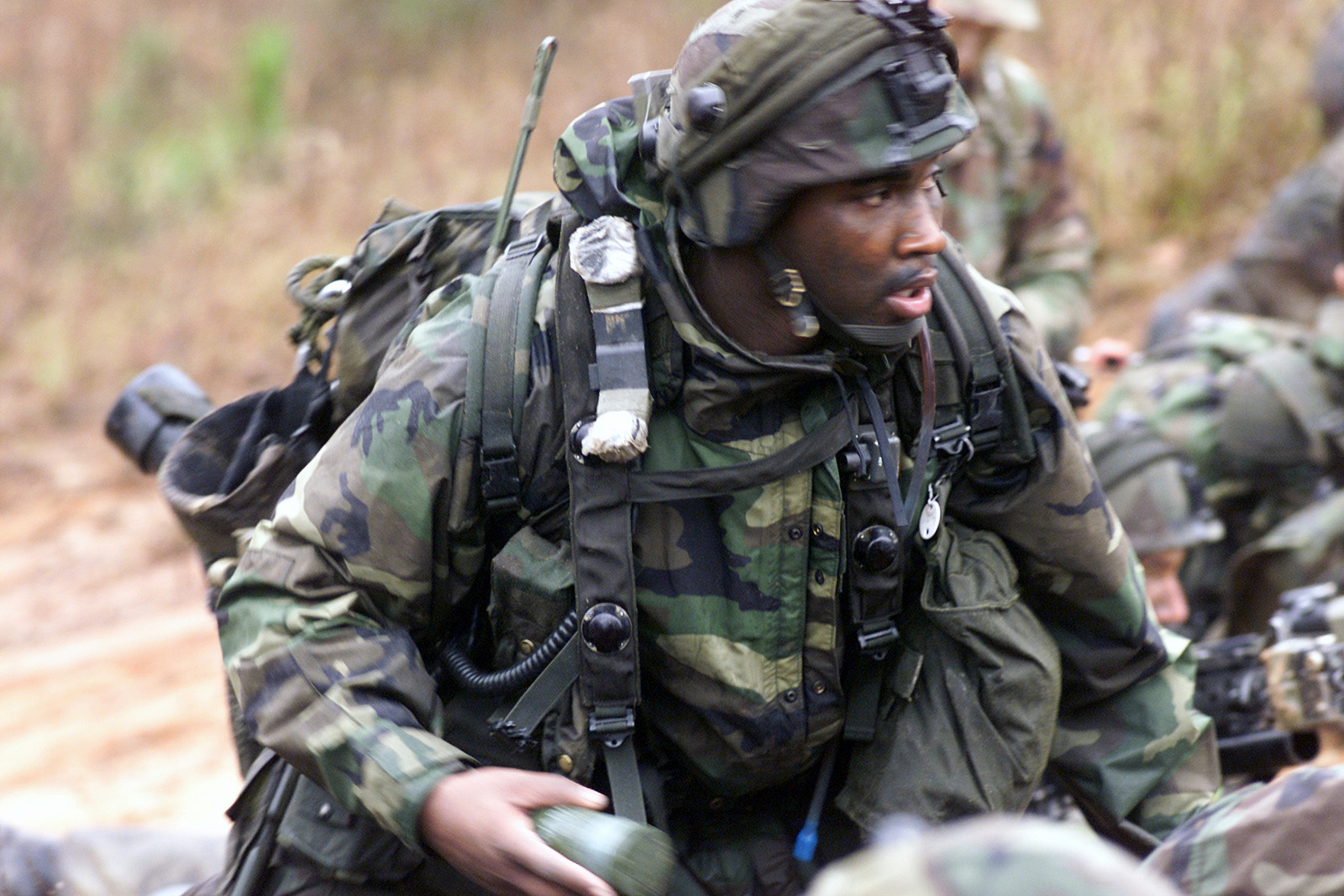
A quick word about what we were doing here. Each soldier and vehicle were equipped with what we call MILES gear. This is a series of sensors worn on your chest and helmet. Weapons have a laser emitter on them. When fired (the weapon is shooting blanks), the emitter activates and sends out a beam. If your sensors detect the laser, an ear-splitting alarm is started from the sensor pack you’re wearing. This means you’re dead.
You turn it off by removing a key from your emitter on your weapon. You then use it turn your sensor array off and stop that alarm.
To go back in play, you need to be brought back from the dead. This involves an officer or a senior NCO with a God Key that will reset your gear.
Our Humvee had sensors Velcroed on it that would emit a screaming sound or a light would start flashing. Some setups are rather elaborate. If enough hits are recorded on say a tank, a smoke bomb would go off indicating a kill.
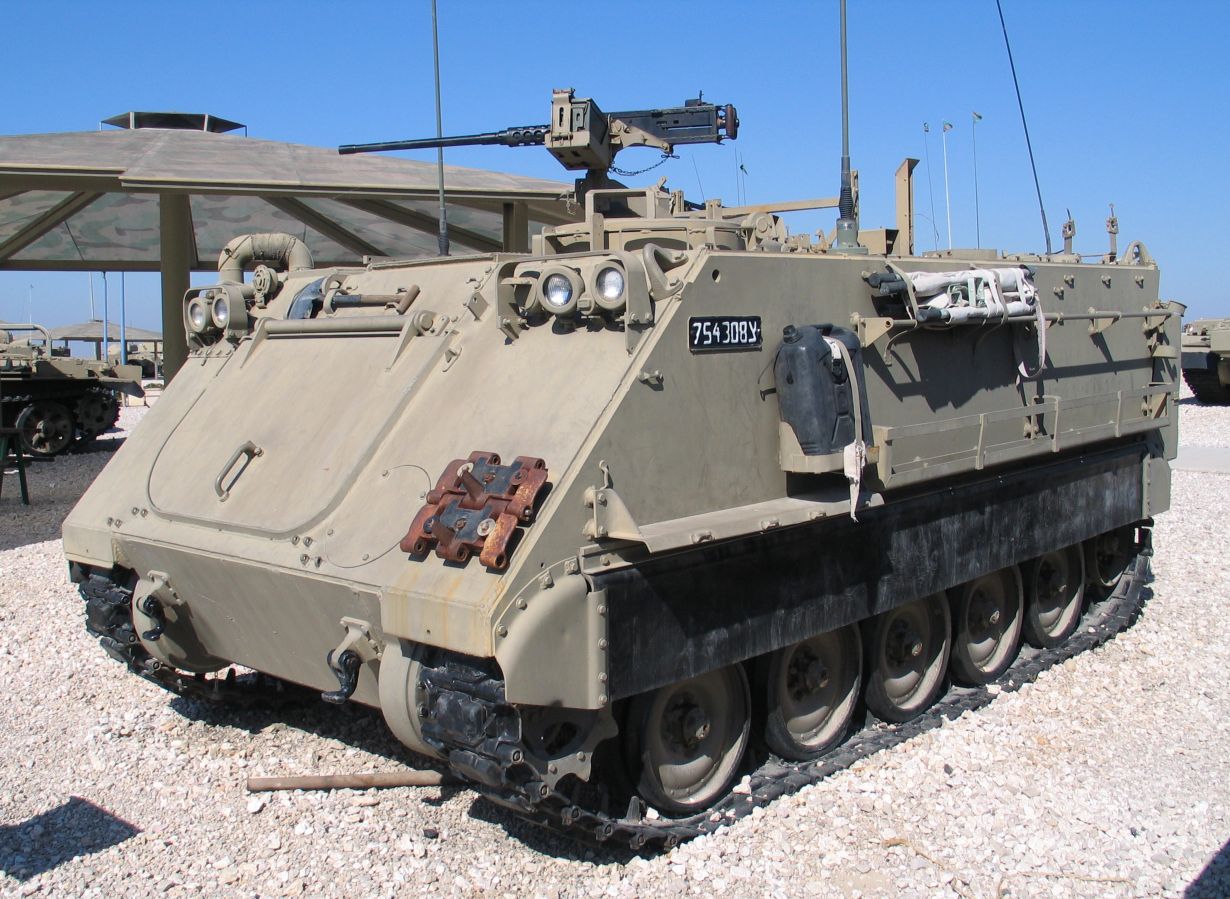
The AT-4 simulator we were using worked on the same principal. We put a charge in it and fired it. The charge went off and that would cause the laser to flash. The M-113s in this case also had a sensor suite that would activate a blue flashing light indicating a kill. We were eager to try the tactic we’d worked up to see if it would really work. I’d already loaded the AT-4 and was ready to hand it up.
We pulled through the underpass only to find our way blocked.
Division, knowing of the impending attack had mounted what’s called an “Operation Save.” In an Operation Save, about a quarter of the supplies and equipment is loaded up. The idea is to move it away from the location. This will provide you with enough supplies to move somewhere else and to get started.
The problem was that several rolls of barb wire had been strung across the overpass. This idea was contributed by Kelley who told us wire was the thing tankers hated most. It tended to get tangled up in the tracks and could even cause a track to be thrown. A military pickup driven by a driver who had brought his seeing eye dog out the field had driven the vehicle right into the wire. It was tangled up in it. The convoy for Opertion Save was on the side of the road. Had they managed to get out, they’d have ran right into the OpFor tanks.
I jumped out, the AT-4 in my hand and the bag of charges around my neck. Several soldiers were standing around the truck with that what the hell do we do now look on their face. It didn’t help when I yelled, “Sargent, get these people into some kind of defensive position! There’s OpFor tanks right behind me!”
The driver of the pickup heard that. He slammed the vehicle into reverse, and drove the pickup straight backwards. He drug this big long line of wire behind him.
My driver is cool and he rolls our HUMVEE forward.
Looking back, we had a pretty good thing going there. The truck and our Humvee would have slowed the OpFor. That is until they either shoved everything out of the way, or just ran over it – which they wouldn’t have done in training. But combat has different rules. Had we buttoned them up in the underpass, we could have smoked them good. I’d have sacrificed a HUMVEE to kill a dozen tracks.
No sooner had my driver pulled through, I heard the M-113s coming through the underpass.
“Get her down!” I yelled to him. The first OpFor vehicle has just came around the small corner. He knew what I meant. Get the Humvee out of the line of fire, find a good place and fight from there. I’ll try to catch up.
My driver floored it and turned right to run parallel to the roadway. He was effectively invisible until the tanks cleared the underpass. My gunner had spun the 60 mounted turret around and was spraying the M-113s with light machine gun fire.
No sooner had he made the turn, the lead tank opened fire with its 50-caliber machine gun. Disabled and destroyed lights flashed from the trucks and the sounds of Miles gear screaming filled the air.
I was right in the way. My alarm hadn’t gone off, and I didn’t fancy being ran over by a tank. I turned and ran up onto the embankment. Now I’m above the Opfor tanks, watching them pass under me. It took a second for me to realize I was in a perfect tactical position. I had an anti-tank weapon. I had four rounds. In a short amount of time, I could do a lot of damage to them.
I put the AT4 to my shoulder, aimed, and fired the first round. The charge went off, activating the laser. Instantly the blue “I’m dead light” started flashing on one of the tracks. I reloaded and fired again. Another blue light, and then a third. Every time I killed one, the APC pulled over and parked.
I was on my last round. I loaded and fired. A fourth light started flashing. Out of ammo, I looked around for my team. My driver had found an almost perfect place. The vehicle was down and well protected, with just the machine gun was sticking up. My gunner was firing at the tanks as were soldiers in the convoy.
I slung the weapon over my shoulder and started running towards my team.
I’d ran maybe a hundred yards when I heard someone yelling at me. Looking I saw an OC (Think an exercise referee). He had a white band around his helmet and he had the “God Gun.”
If an OC decided you’d done something really stupid, they would point the gun at you and kill you.
My first thoughts were, “Crap, I’m dead!”
I ran over, reported, and to the OC (an Infantry Major). He sticks out his hand and says, “God dammit, Sargent. That’s the best tactical maneuver I’ve ever seen anyone pull.”
Of course I meant to do that.
I thanked him and ran to rejoin my team.
We soon joined the rest of my Platoon, and we raised living hell with the OpFor. One of the advantages we had was Sgt. Kelly knew the M-113 forward, backwards and upside down. He knew it’s blind spots, and how to approach it without being seen. In several cases we were able to take out the gunner and silence their offensive capability. Then it was a straight forward exercise to take out of the tank at that point.
Of the fourteen vehicles in the assault, not a one escaped. My team killed four of them, Sgt. Kelly another three, and we all just took the rest of them on.
For all that, we lost one team. Fortunately, it wasn’t real. Twenty-four hours later, they came back from the dead.
Our LT had learned that static fights don’t work well on the mobile battlefield. He labeled what we’d done “The Swarming Bee Defense.” And that’s exactly how it worked. We hit, we stung (and killed) and moved on to the next one.
Afterwards, the OC and the OpFor CO sat down for the after action review with us. The small convoy of Operation Save was deemed administratively dead.
But they all admitted that had this been a real fight, we’d have won it hands down. We would have saved the TOC. The OpFor CO said we (the MPs) rattled them with our constant attacks. They were busy just trying to defend themselves against us.
It was some of the most fun I’ve ever had out in the field.
But now, here I was in the Saudi Desert. Soon, it would become the Iraqi desert.
Out there were real T-72s and BMPs. They didn’t fire lasers into a sensor that informed you that we were dead. They fired real tank rounds and bullets. Those informed you were dead when you found yourself standing before the throne of God.
The sun went down while we were still moving. We drove in the dark, guided only by blackout markers. Somewhere around 10 PM we crossed the border into Iraq. There are these large berms of sand bulldozed up on the border. Our engineers had made roads through them. It seemed that every bit of traffic in the world was headed right for those openings. In the dark, all we could see were the small red blackout markers of other vehicles. We spotted one of the vehicles with the convoy we were with and stayed focused on its black out markers. I hoped it was doing the same with someone else from the convoy and so on.
That was hard, because if you blinked or looked away, it was sometimes difficult to reacquire the black out markers.
Somehow, Battle Central made it through the narrow gaps intact, and with no one following the wrong vehicles.

We traveled for several more hours and finally stopped for the night about two thirty in
the morning.
I slept in my seat, my elbow on the windowsill. We were moving early the next morning.
But before we got going the cooks showed up with boxes of breakfast sandwiches.
I haven’t a clue when they set up the kitchen or cooked them. For all I know, they cooked them before we left Saudi and just kept them on ice. They were just a friend egg, a slice of cheese, ham and mayo between two pieces of bread.
I hung the name of 1st AD Sandwiches on them.
They’ve been a favorite breakfast since in my family.
Of course, when I first reproduced them, my kids called them “First Eggee Sandwiches.”
Now, if I’d have had some green chili to put on mine, it would have been 100% perfect.
Not that I’m complaining.
Discover more from William R. Ablan, Police Mysteries
Subscribe to get the latest posts sent to your email.
 William R. Ablan, Police Mysteries
That was a real storm, facing all those M-113s. The AT-4 must have been very effective. Were they heat rounds, that would burn their way through and set off the ammo inside?
LikeLike
Armor piercing with an explosive. At-4s were very effective weapons. The were very effective against bunkers. Probably wouldn’t take out an M-1, but they could take out an T-72 or at least seriously damage one. They’d have handled an M-113 or a bradley very easily. For a tank, we’d have wanted a Dragon or a TOW, but those are wire guided and not fire and forget weapons.
LikeLiked by 1 person