
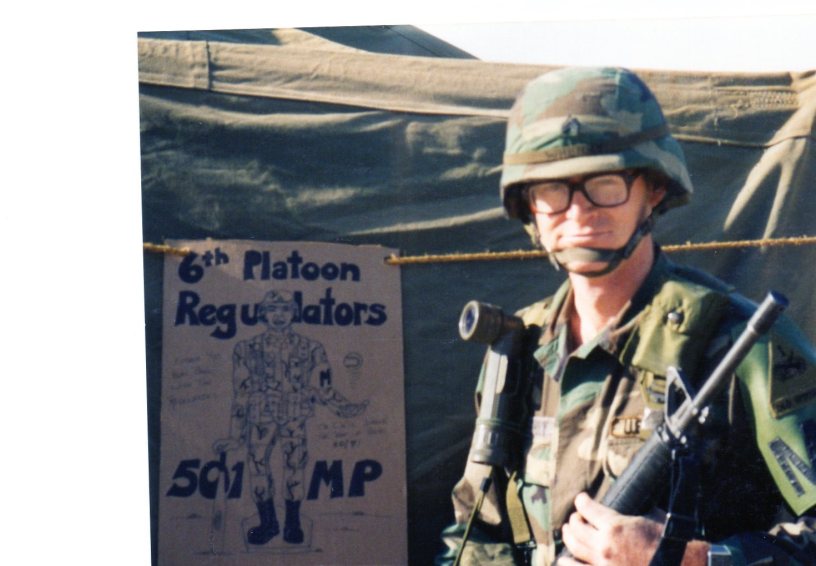
One person I haven’t spoken much about was our platoon daddy, SFC. Michael Gellizeau (hope I spelled that right). In a lot of the pictures I have, he can be seen wearing a jacket, maybe even a parka. SFC G suffered from some blood disorder. I don’t recall what it was. But he was almost always cold.
He had a profile that allowed him to wear jackets and parkas in the heat of summer. One thing I recall him wearing is what some people call, a “Lifer’s Jacket.” This is a raincoat into which a nylon liner has been sewn. When we did the Nijmegan road march, we’re all sweating in the August sun. He’s zipped up in that and cold.
Another thing he did was to work out like a machine. As a result, he was one seriously in shape individual. A memory I have is running to Checkpoint Bravo and back with him in the desert sun. We were in full combat gear and was a distance of about five miles round trip.
It felt pretty good.
Training of course was high on our list.

Since Saddam had a decent chemical warfare capability, we did a lot of NBC (Nuclear, Biological, and Chemical) training.
Before we left Ansbach, I’d picked up a secondary MOS (Military Occupational Specialty). I’d always been interested in Chemical Warfare Defense and so I went to a two week-long school. I’d be back up our NBC NCO, SSG Patterson.
I helped her deploy and keep up the monitors, train soldiers, and test their gear.
A very frightening incident after the air war started. We were doing some NBC training and were reviewing how to detect nerve agent. This involves a test kit, and a small procedure. Lacking training kits, but having plenty of the actual kits, we used them.
The procedure is simple. You wipe an object, use some test chemicals, and if it changes colors you have a positive test for nerve agent.
So here we are training, and damned if the test didn’t come up positive. I reported that to SSG Patterson and she runs it up the chain.
The explanation we got was this. They were hitting Saddam’s chemical weapons depots. The stuff was going up in the air and some of it was coming down on us. They said it was in such low amounts, it wouldn’t be a problem.
Right!
I wondered what prolonged exposure, even to small amounts might do. Maybe it had something to do with some of the issues our troops have reported.
Before leaving Germany, so of the guys went to what amounted to a crash course as a medic. They could even start an IV if needed. My EMT certification was still good so we had a good medical team if needed.
I also helped check everyone’s protective mask for fit. What this involves is the soldier sits in an enclosed area. In this case, we used one of the HUMVEEs. They entered wearing their protective mask and I waved a rag around them that had banana oil on it. If they smelled it, their mask wasn’t fitted right, and we’d fix that.

We also trained for calling in fire or air support. What this involved is a map, binoculars, and trying to determine where a target was in relation to the map. We’d call grid coordinates off the map of where we thought the target was. If we were correct, they’d drop shells on target. The idea was to watch where the first shells fall and adjust. If it took you more than thirty seconds to destroy the target, it was probably gone already.
I should point out this was best guess since we really weren’t calling anything in. Back in Germany, we’d have done that in a simulator. No such luck here. It was all classroom without the benefit of a lab experience.
I’d done this once before with 977th MPs shortly after I arrived at Ft. Riley. We had a young Sgt who had re-enlisted to be an MP. We’re in the simulator. He looks at the target on the screen, looked at the map and rattled of the grid coordinates. Then he said, “Fire for effect!”
“You sure?” the Sim Operator asked.
“I’m sure. Fire for effect.”
He pushed the button and on the sim screen, the target was obliterated.
“You’ve done this before,” the Sim Operator said. “Field Artillery?”
“Forward observer,” he confirmed.
I was never that good.
Previous – The Smell of a Woman Next – Mail Call
All photographs Copyright – Richard L. Muniz
Discover more from William R. Ablan, Police Mysteries
Subscribe to get the latest posts sent to your email.
 William R. Ablan, Police Mysteries
It’s good you made it through that, William, and that you’re still alive.
LikeLiked by 1 person