

A constant fear was Saddam would do a preemptive strike on us before we got up to strength. We still had very little ammo but we did dig in, just in case. At least we might have a little protection. While the other platoons simply dug fox holes, The Regulators of 6th platoon were a little more motivated. We built a series of fighting positions connected by trenches.
Looking back, a lot of this was “Make Work” but at least it made some kind of sense. One question I’ve always been asked is why didn’t the engineers do this for us. It’s a good question and one that deserves an answer. After all, a couple of backhoes could have dug everything in a couple of hours.
Truth is, they just didn’t have the capacity. We weren’t the only unit out there and they had enough taskings. I do recall they sent out a bulldozer and grader to make the tank ditch around the company area.
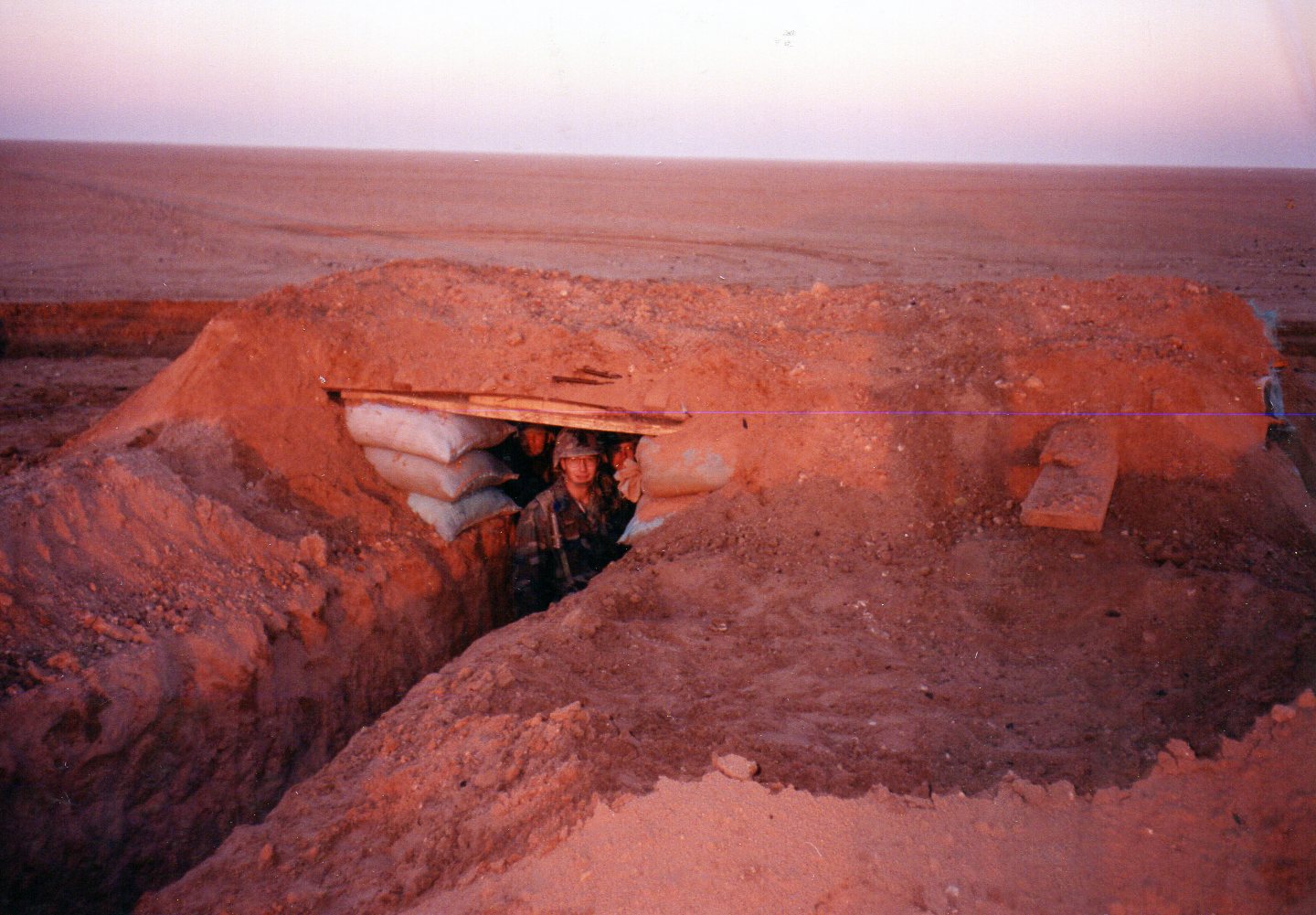
Since shovels and picks were made before backhoes, we got to do it the way our grandfathers did things. I’m actually glad I was raised on a ranch. I knew how to use a shovel and a pick. I was more than ready for it. But digging into the Saudi desert was like trying to hack your way through the armor plate on a cruiser. The ground was hard and we were moving a lot of dirt.
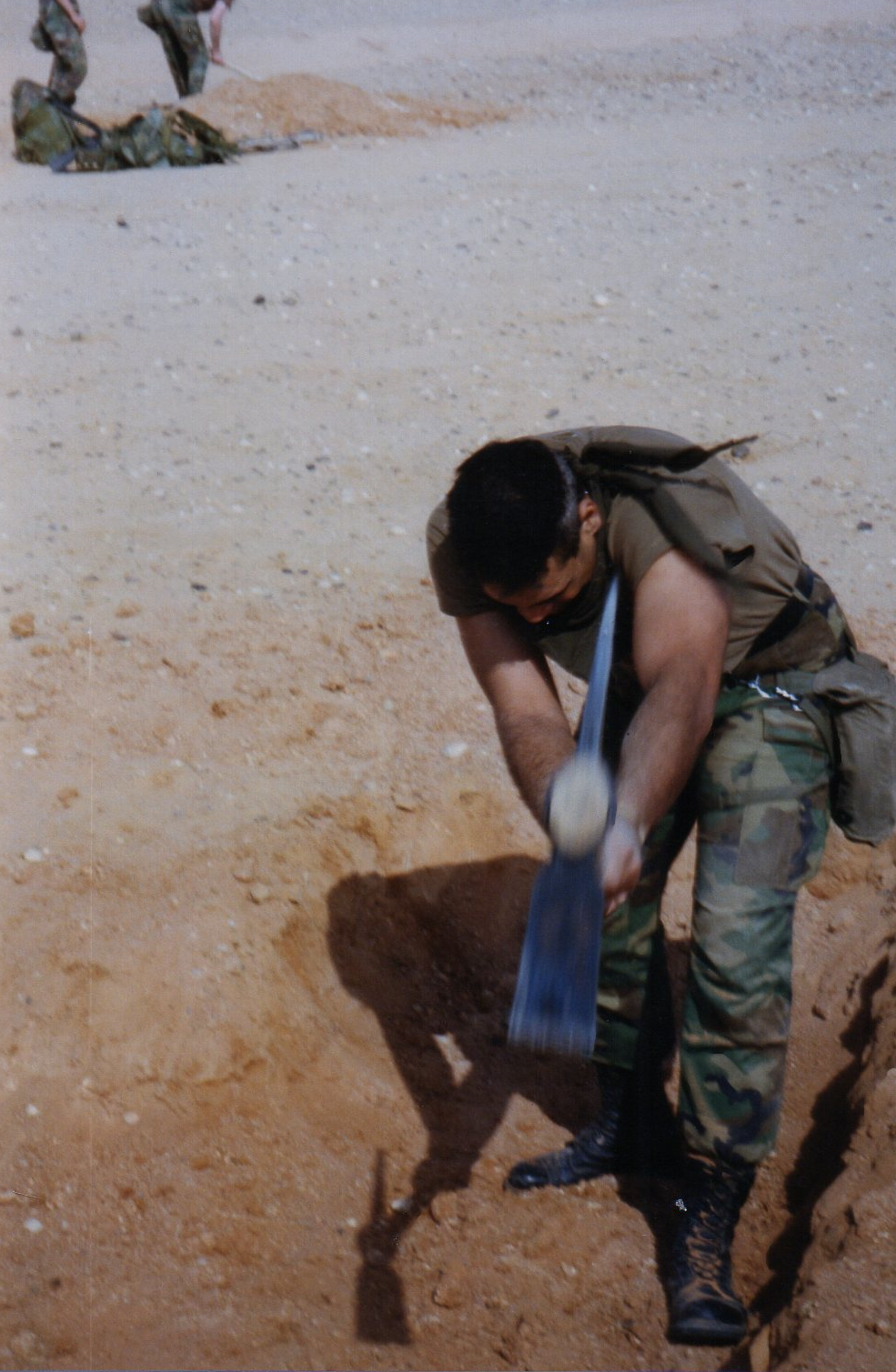
The idea was simple. You hacked up two- or three-square feet of ground with the pick. Then you shovel that out. Repeat until you get the depth, length and width you want.
What we had going for us was there were a lot of us in the platoon. The Bible says “many hands makes heavy work light.” I don’t know about the light part, but we did a lot of heavy work in a short time. Even still, it was several days before we got things the way we wanted. The bunkers were large and, all things considered, comfortable.
According to the book, to make a good fighting position, you want it dug into the ground. You need good cover.
Now there’s a difference between cover and concealment. Cover means protection from bullets. It’s also a relative term. What will protect you from a bullet, won’t protect you from a HEAT round. In our case we had a triple thickness of sandbags. These in turn were covered with dirt. Overhead cover again covered with more sandbags and dirt.
You want to make sure you’ve got good fields of fire.
Concealment means making something is hard to see or hidden. The theory there is if you can’t see it, you can’t kill it . . . Easily that is. In the mountains that might mean camo netting or covering something with bushes and etc..
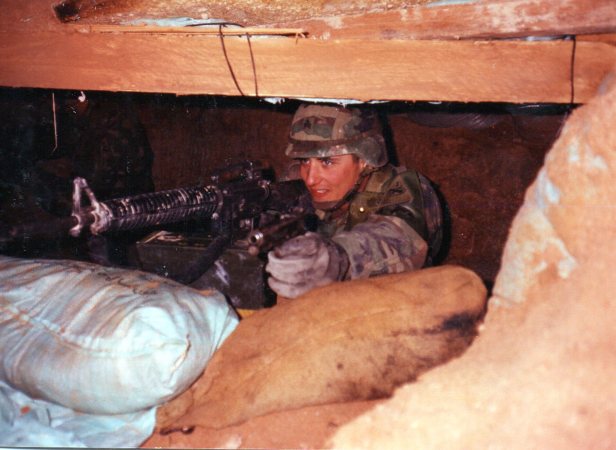
Where we were was flat. It was so flat that if I stood on a coffee can, I could have seen the Alps. Anything that was above the ground more than two inches stood out for miles. Hiding them was almost impossible. There was no sagebrush to help hide us. Nothing. The best we could do was make it blend best we could.
And the book says that you dig “grenade sumps” into the sides of your holes. These are pits about two to three feet deep. The idea is if a grenade is tossed in, you might be able to kick into the sump. There it would explode harmlessly (again a relative term) and hopefully save you and your buddies. At the very least, you’ll need hearing aids for the rest of your life.
I’m thankful that we never had to put that idea to the test.
We’d managed to scrounge wood and, in some cases, even steel to provide overhead cover for our fighting positions.
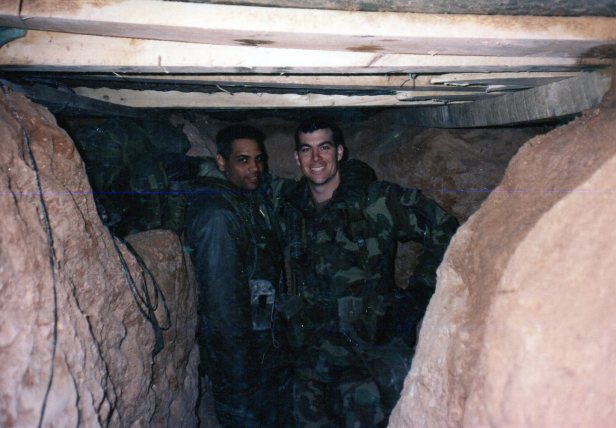
Days later we were ordered to remove the cover. Apparently, someone had a bunker cave in on them (not our unit), and there were several injuries.
We did as ordered and thought all along how naked we now felt. I’m sure all of us had visions of an overhead burst and steel raining down on us at supersonic speed.
All things considered, the explosions themselves might have caused the roof to collapse.
Later, you’ll see some bunkers the Iraqis dug. Ours were small by comparison. Of course, we weren’t living in them either.

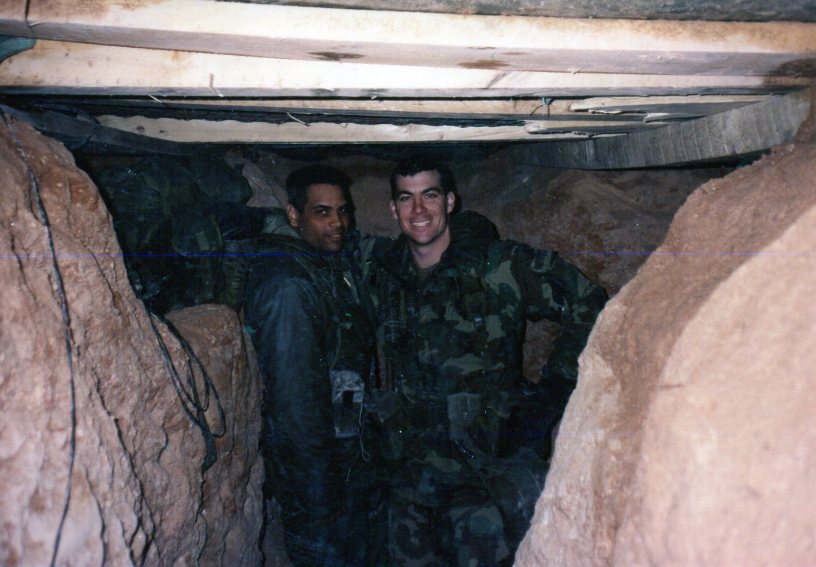
Our fortifications were large and comfortable. Notice how that one beam is sagging down. Maybe taking the overhead cover wasn’t such a bad idea after all. In the picture from back to front: SSG Hahr, SSG Honor, Cpl McArtor.
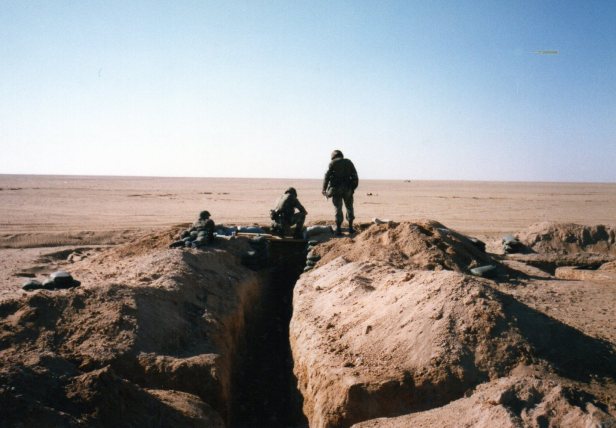
One thing we did was dig trenches between the fighting positions. A WW I Doughboy would have felt right at home in them minus the mud. They were deep enough so we could have gone from one position to other without being seen.
I’ve gotten up on Google Earth and looked at the imagery of where I “think” we were. I found what might be the perimeter of our camp (the engineers dug a ditch around it). I’m not finding any of the fortifications we made. I suspect they were bulldozed over shortly after we left. After all, driving into a hole in the ground can hurt.
Maybe some future archaeologist will find our fortifications. They’ll get excavated and maybe find the letter in an envelope in a steel bottle that proclaimed “Kilroy was here.” It had our unit and a list of names on it. I buried it in the Platoon leaders bunker floor so it’s at least seven underground now.
Good luck digging it up.
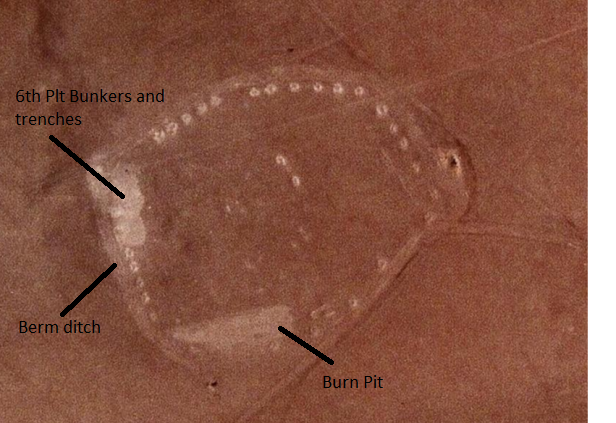
Thank you, Google Earth!
Previous – Checkpoint Bravo Next –The Smell of a Woman
All photographs Copyright – Richard L. Muniz
Discover more from William R. Ablan, Police Mysteries
Subscribe to get the latest posts sent to your email.
 William R. Ablan, Police Mysteries
That must have been some serious work, William. I think it was the right thing to do.
LikeLike
It was. To be truthful, looking back it was a feeling of accomplishment, even if we never needed it. I’d never felt such a kinship with the soldiers of ‘Nam, WW II and WW I as when we finished those.
LikeLiked by 1 person
Good stuff, keep it coming. The Gulf War is something folks don’t write about.
LikeLike
I agree. I often times wonder if it’s not because we won that one.
LikeLike