


I was raised a rancher. Keep that in mind. It’s important here.
Most people would say anytime in the summer or winter was their favorite time. My favorite time would be that gray area in between September and December.
Both summer and winter were hard seasons for me in the San Luis Valley.
Winter often saw a scrambled amount of activity when we got back from school. That meant feed cows, chop open the water hole over the river, and bring in firewood. During December and January, these tasks were often finished well after sundown. Add to that calving season and it made for a busy time of cold and lots of work with numb fingers and toes.
Summer was also a time of hard work. That season always began around late March, early April. That’s when the cows were vaccinated and the new calves branded. that was a full day that started early, and didn’t stop till late in the day. All of this was preparatory to taking them to our summer range in New Mexico.
About the same time, irrigation of the fields would begin. While we had a nice meadow, we also had fields of alfalfa planted. The fields and the hay we’d harvest from it, represented the food we’d give the cows over the winter.
Today, a lot of farmers have automated irrigation systems.
We didn’t.
Our way to get the job done was the old school way that had been practiced for thousands of years. About all that changed was some of the technology. We had water come down a ditch. We put canvas dams in place and used irrigation siphon tubes to flood out a field. This would happen a couple of times over the summer. It was several weeks of back breaking work.

But that was after we had the place leveled. Before that, the lay of the land was pretty much as God had made it. That made irrigating difficult. When we first started doing irrigation on the property, my grandfather came up from New Mexico. Grandpa was an irrigator from way back and he could read the lay of the land easier than most people can read a comic. He knew exactly where to put canvases, and it made our job so much easier.
Depending on how bad the winter had been, we’d go up to the summer range in April or May and put the fences back up. We used drop fences up in the mountains. These were made of barb wire and the wire nailed to 2x2s. There were metal posts driven into the ground, the fence got stood up and tied to those posts. The idea is simple. A standing fence needs to be tight. Now, if you remember your high school science, you know that an object contracts when it gets cold. A standing fence would contract so much that the wire would be busted almost every other post.
A drop fence is designed to mitigate against that and to be dropped prior to winter. We just undo the wire that’s holding it to the metal post, the fence falls down, and that gives it a lot slack. I’m not saying wire doesn’t break, it just keeps breakage to a minimum. This is a task that can easily take a couple of days to get the fence up or down.

Around early or mid May, the cows were sent to the mountains. A semi or two would show up and in another marathon session, we’d truck them up to the corrals on Cumbres Pass. We then had to cover about eleven miles of private and public lands. The public lands were under the oversight of the National Forest Service, and we had to have a permit to cross it with the cows. One thing the Forest Service was adamant about was that we had X amount of time to do so and it never seemed long enough.
Since I hated riding horses, I hoofed it from the corrals to the summer range which was a distance of about eleven miles or so. I consider it some of the best training I could have ever received it for the Army, marathon running, and extreme sports.
Then, we’d go up into the mountains at least every other weekend (usually more often). The summer range was in easy driving distance (hour and half), but doing that meant an early morning, a lot of work in between, and then coming down in the evening.
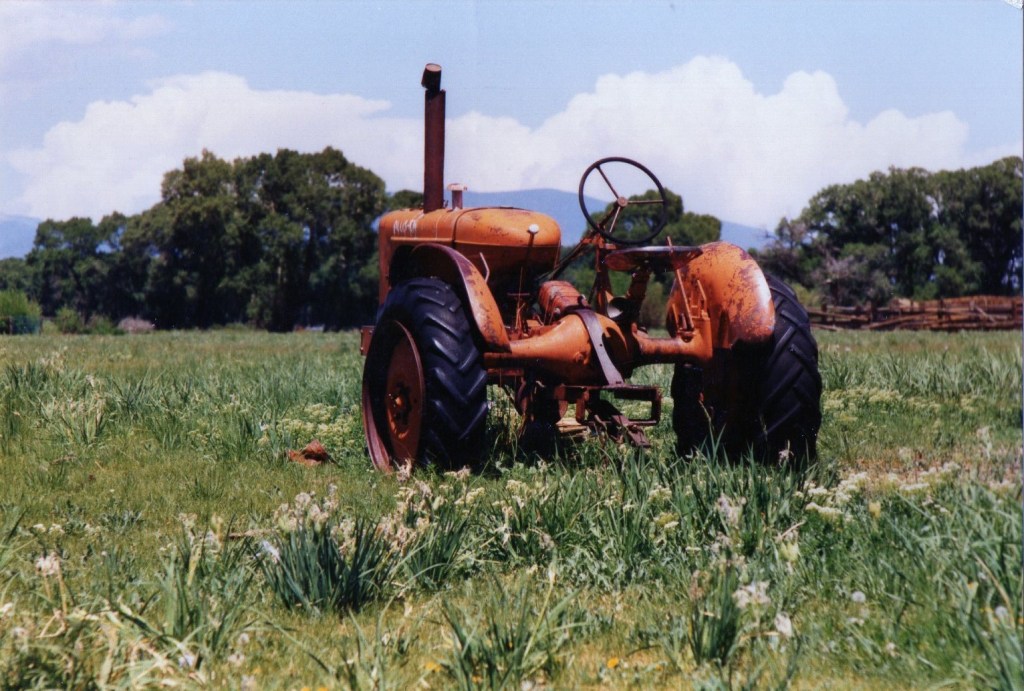
Somewhere around late June, early July, the first cutting of hay was done. My brother usually cut it, I racked it up into rows using the old tractor, and then he baled it. If it rained, it might mean turning the rows of hay so it would dry. If it had already been baled, we had to turn bales. Putting hay up wet isn’t a good idea. If it’s wet, even a little damp, you could see your haystack go up in a puff of smoke and flame.
(copyright – 5th & Cherry Books)
When the bales were ready, we had to bring them in from the field. Today, a single person, with a bale stacker can clear several thousand bales in a day.
We didn’t have any such luck. In the beginning, we were bringing in the hay using the old pickup truck. If you’ve never bucked bales, these are rectangular objects. They weigh between from 70 to 140 lbs. The best we could do was maybe forty bales at a time. More than once we were still bringing in hay while the second cutting was growing up around it.
We finally got an actual bale loader, a larger truck and could average 120 at a time. It made things easier and not so labor intensive.
Our food of choice for this back breaking work was spaghetti and lots of it. It was the carbs and the heavy load of protein in the form of hamburger that kept us going.
Another summer activity concerned staying warm over the winter. The ranch house depended on wood heat to help keep us warm during the winter. That meant several weeks of chopping and stacking wood. Wood had to be allowed to dry before burning. It took several months under the summer sun to dry it out enough to burn.
Then, depending on weather, the cows came back from the mountains. This would be mid or late September before the snows set in. it was another get up there, herd them back, and truck them home.
Usually, we didn’t have any trouble, but once, the weather closed in on everyone else and made for tough going. That was my senior year in high school and because of things that had to be done, I missed it.
Just as well. A number of vehicles broke down and came in on tow trucks that year.
The return of the cows from the mountains signaled a shifting of the workload. Except for dropping the fences up in the mountains, most of the summer work had been completed. There was ample forage for the cows and calving season hadn’t started yet.
By now, it would be October. It was a short time to catch our breath, rest, maybe even catch a nap. There was one major thing that seemed to happen in October. The steers would be taken to the auction barn in Monte Vista and sold. We’d eat at a restaurant up there. I remember on one of those occasions, we ate at the Pirates Cave in Monte Vista and had shrimp. That was big treat for us.
The sale of the steers would pay mortgages and bills. But we always got at least some money out of it.
I remember one year I purchased myself an AM/FM radio from some of the money I received. I got it at Woolworth and it cost a whopping ten dollars. It had an earpiece I could plug into it. At night, I’d turn the radio on and I’d lay in bed listening to XROC 80 out of Juarez, Mexico (good rock and roll). Or I’d tune in KOMA out of Oklahoma City (I was raised on that station).
Man, I thought radio that was something
Discover more from William R. Ablan, Police Mysteries
Subscribe to get the latest posts sent to your email.
 William R. Ablan, Police Mysteries
I thought you liked riding horses, so this is an eye opener in many ways. Dad always enjoyed October and November–corn and soybean harvests, also meant he could pay his bills. A neighbor, retired optometrist, still drives his dad’s Allis Chalmers WD45 in parades and for hayrack rides. I don’t suppose your grandfather’s is still around. That’s a great photo of it!
LikeLike
I can’t imagine hating horses.
LikeLike
Got nothing against horses, just I[ve never been a big fan of riding them and would ride one only if I absolutely had to. Might have something to do with some of nags we owned.
LikeLiked by 1 person