
I wasn’t around to see it in 1910.
I wasn’t in a good position for it in 86. The comet was too far away to put on a great show and when you’re in Basic Training, you don’t have a chance to do too much stargazing.
And I won’t be here when it comes back in 2061. I’ll be 104 years old and will likely be looking at flowers from the wrong side.
But it doesn’t matter. With or without me, Halley’s Comet is coming back. And this time around, it’s supposed to be in position to put on a decent show.
At this moment in history, the comet isn’t much to look at it. It’s roughly peanut shaped and measures a mere 15 by 8 KMs or so. Being made of rock and ice, it’s not terribly bright. You’d imagine it glittering in the distant sunlight, but truth be told it’s not a terribly bright object on its own. Comets have been called “Dirty Snowballs” and that’s about right. Many of the other comets we’ve visited look more like rocks than snowballs. The tail is probably non-existent. it’s too cold out there at the edge of the solar system and the distant Sun provides little warmth. it’s quiet.
But things are changing. A few weeks ago, somewhere beyond Neptune, Halley’s’ comet reached its furthest point from the Sun.
For the last thirty plus years, it has been climbing slower and slower away from the sun. It reached a point where it wasn’t moving fast enough to keep moving away from the sun. For a fraction of second it stopped moving away from the sun. Then the gravity of the sun slowly began pulling it back. Now, it’s falling slowly towards us.
But there’s really not much to look at yet. It’s almost a given that Hubble or the JWTS telescopes can find it. So could the larger scopes on the ground. But at this moment in history, the comet is little more than a frozen rock. Even in the most powerful telescope, it would be nothing but a dot moving against the background of stars. It won’t be till it starts closing on the orbit of Saturn or maybe even Jupiter before we can expect to see any activity. It might be getting enough warmth from the sun by then to start melting some of the ices that make up the comet. Maybe the first hint would be a telescopic image that shows it not a speck, but a fuzzy speck.
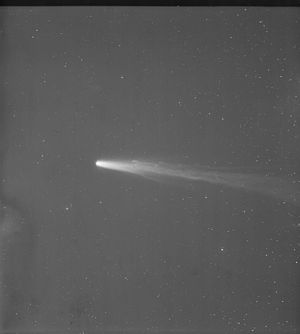
As it closes on the Sun and it gets warmer, more and more ices melt away. If you were to walk across the comet, it might resemble a snowy day in Yellowstone and geysers of liquid erupt from vents and cracks in the surface. All this rains up into the sky where the light of the sun catches it. Bathed in the light of our Sun, the cloud glows. The solar wind pushes this all out and away from the comet forming its magnificent tail. It will be falling fast by then and gathering speed with every passing second as it zooms through the inner solar system.
It moves so fast it starts to climb away from the Sun. As it does, it cools. The geysers eventually go quiet, the tail blows away, and it becomes just one more cold rock orbiting the Sun.
Halley’s Comet has been recorded since before the Birth of Christ. The Chinese left us records of seeing it as early as 240 BC, and Babylon tablets record it in 164 BC. There’s even a mention of what might be it in the Talmud. There were hundreds of observations made of it, but it wasn’t until Edmund Halley, an English Astronomer, realized it was the same comet. He computed its orbit, and predicted when it would be back. And sure enough, it did.
The last time it was in for a visit, the comet was poorly positioned to put on a good show. That didn’t stop us from having a fleet of space probes waiting to meet it. One probe in particular, Giotto from the European Space Agency flew through the tail of the comet.
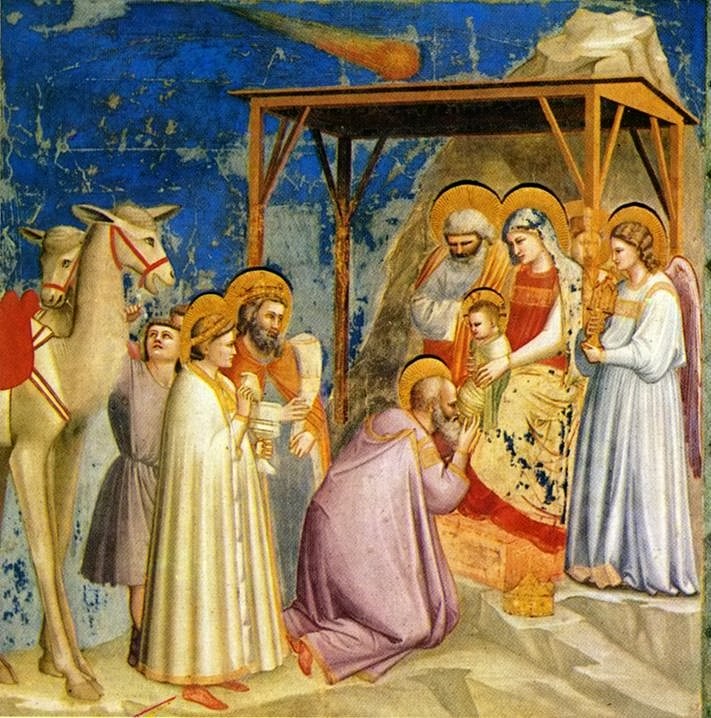
Giotti was named after the famous Italian artist Giotto di Bondone. One of his paintings is of the Nativity and arching over the stable Christ was born is Halley’s Comet. It was in a position to have put on an epic show in 12 BC, and while a little early, some Theologians suggest it might be what the Magi noted.
The probe bearing his name, was launched on 2 July 1985. It wasn’t alone. The Soviet Union sent two probes to track with the comet, as did the Japanese. But Giotti was purpose built to get up close and personal to the nucleus, that active center from which the magnificent tail flows. Prior to that, we’d visited only one comet, and that was by a dusted off lunar orbiter that was flown out of orbit to meet with a small comet.
That comet was nothing like Halley. Halley is a monster spewing out ice and rock. Giotto was expected to be seriously damaged and possibly destroyed.
Giotto began its Halley’s encounter on 14 March 1986 and came within 596 KMs of nuclease (370 Miles). The ride was a little rough. The probe was sandblasted and took strikes from several larger (unknown size) pieces of material. One strike knocked it off its stabilized axis and it lost contact with Earth. The impact also spun the spaceship around so that the shield that would have helped protect the craft, no longer could. The ship and its instruments were exposed to the full fury of the comet. Somewhere during all this, an impact destroyed the camera, but not before it took Halley’s closeup.
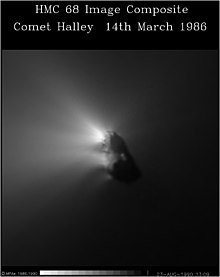
When the craft came out of the tail, it reoriented itself, found Earth and called home.
I like to look at that picture the probe took once in a while and imagine what it might have been like to ride through the tail of that comet. And once in a while, I go out and look in the direction of the constellation of Hydra. Someplace out there is the comet I will never see.
But my grandchildren will, and my great grandchildren, certainly. Maybe Next time, one of them will board a spaceship and fly out to meet it.
But we live in a universe where nothing lasts forever. Every time Halley comes around, it loses some of itself. We already know it’s peanut shaped. Could that be an indication that it’s really two or more bodies stuck together by ice. As that ice melts away, will it one day break apart and on some future visit, we’ll see two comets? This has happened before. It might make a few more passes and then one day, we’ll look for it and nothing will be seen.
Or maybe it will die with a whimper. As more and more ices melt asway, there may be little left one day. Halley may become a shrunken dwarf of itself on its eternal orbit. Our descendants will need a telescope to see this slightly fuzzy object and wonder what the big deal was about it.
That wonder in the dark will be gone. So, if you’re here when it comes next time around, enjoy it.
Discover more from William R. Ablan, Police Mysteries
Subscribe to get the latest posts sent to your email.
 William R. Ablan, Police Mysteries
I’m also fascinated by Halley’s Comet. I took 11-year-old Dan to the darkest places we could find in 1986, but could only find a smudge that might have been Halley. Grandma Leora saw it well in 1910 while at Mrs. Connrardy’s sewing school in Exira! (Yes, it’s mentioned in Leora’s Early Years.) She’d hoped to see it in 1986 but it just wasn’t clear enough.
LikeLike