
NOTE: A lot of people have heard of the people who actually built the Atom Bomb. But for every Robert Oppenheimer or the like, there were dozens of ordinary men and women who had a ringside seat to history. Some were MPs. Some were Army Engineers. Others housewives. Some mere people who had no idea what this was all about.
I’m trying to tell the story here of ordinary men and women caught up in the amazing. Enjoy.
“You’ll love this place, sir,” the young NCO told Captain Bush (some sources give his rank as Lieutenant – I will go with Captain) .
The Captain looked around at the miles of empty desert pocked with sagebrush and gopher holes. He couldn’t imagine anything being nice about the place.
“What makes you say that, Sergeant?”
“We’ve got hot and cold running snakes here.” The Sergeant laughed like it was some kind of joke.
Captain Bush couldn’t see anything funny about it.
If there was such a thing as the Middle of Nowhere, he was in it. South of Albuquerque, New Mexico, and not far from Socorro he might have wondered why he and roughly a company of troops had been banished out here. All he was told was to establish a military presence there, keep unauthorized people away, and that was it.
I’m sure he wondered if he’d made someone upset and that’s why he was out there. The place had all the earmarks of somewhere you could end your career in a hurry.
I’m also sure he wondered at what he’d been instructed to tell his men. “You don’t talk about and you don’t write about anything you see and hear out here.”
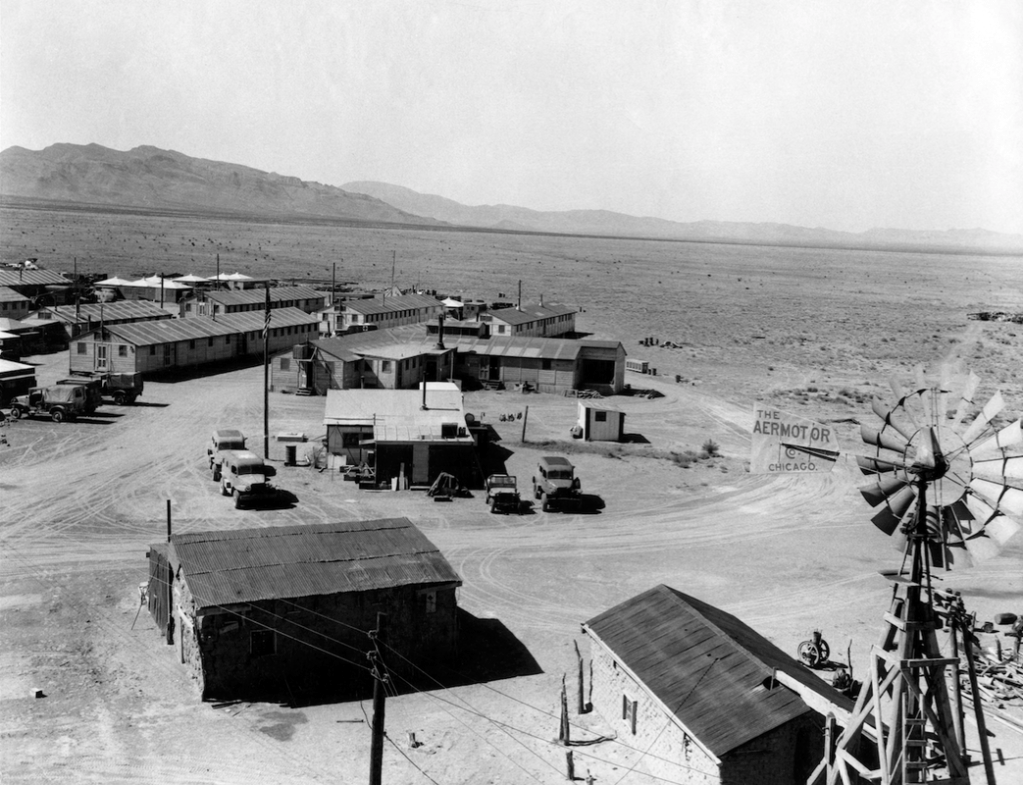
There were several tents, a mess hall, a few prefabbed buildings, and a ranch house. In the briefing papers Bush had seen, the place had once been called “The McDonald Ranch.” The Government had come in and evicted the ranchers, saying they wanted the property as a bombing range. Anyone who had carved out a foothold in that rattlesnake-infested, sagebrush blighted region weren’t about to bow to the government’s wishes. They drug Uncle Sam into court.
Of course they lost, but were compensated some $60,000 for their property. They moved out, no doubt under escort from the Sheriff, and the Army moved in.
Now Captain Bush looked around. No one knew they were out there. This place gave the word “Remote” a whole new meaning. I’m sure he didn’t know that in this desolate place, the world would be changed forever when the first atomic bomb exploded.
This wasn’t the only place the military looked at for this site. There were a number of sites evaluated in New Mexico, California, and Colorado. Ultimately, they settled on this site in New Mexico.
The reasons were straightforward. “Trinity was close to a highway and railroads, and Los Alamos,” Jim Eckles, a man who had worked the site for thirty years explained. “It was also already under the control of the military. It met all the requirements.”
Richard Mezler, a retired History Professor from University of New Mexico, held a different opinion of why the site was chosen. “I always told my students that the reason they chose us was that no one had ever heard of us. So if things went badly, we wouldn’t be missed.”
The site was part of the Alamagordo Bombing range, and this part of it was called the “Jornada del Muerto.” The name Jornada del Muerto is Spanish as “Single Day’s Journey of the Dead Man” or “Route of the Dead Man.” A more modern literal translation is closer to “The Working Day of the Dead”. Either way you cut it, it was fitting for what was about to be given birth there.
PERSONAL NOTE: In the case of Colorado (since this was the San Luis Valley, where I was born and raised), the Military seriously looked at a site east of Mosca, Colorado near the great Sand Dunes as a possibility for the Trinity tests. I’m not upset they didn’t choose it.
Military Police started coming in on December 30, 1944, Cpl. Marvin David was one of the first out to what would be called Trinity Base Camp. They’d been working at Los Alamos labs, and were detailed to set up security check points and establish security.
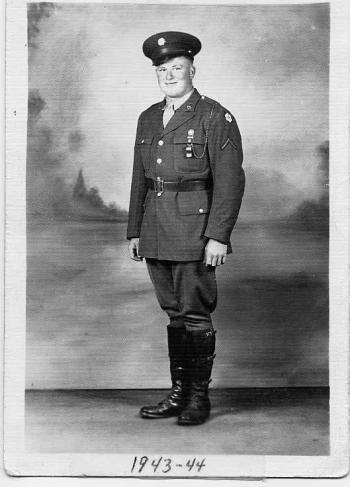
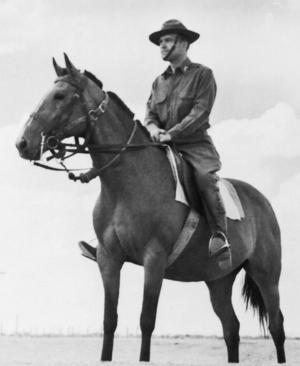
“The initial idea was we would be mounted MPs,” Davis said. “That meant horses. We’d ride around the area like some cowboy and keep people out.”
The horses were brought in, complete with saddles and bridles, and the MPs were sent out on patrol. There were a couple of problems with the idea. First, the area they had to cover was vast. The horses just weren’t fast enough to allow a good patrol. Also, more than a few of the MPs were city boys and the only time they’d even seen a horse was in a movie. It takes some time to become a good rider, and they didn’t have it.
The horses were left behind in the corrals and jeeps were used.
The distances involved at the site made a lot of things difficult. One was feeding the MPs at the distant checkpoints. Getting them in was problematic and taking food to them worse. C-Rations were a godsend, but when electricity at the remote sites was finally established, many of the sites would fix a quick meal on a hot plate.
One of the first things that had to get fixed was the water situation. The McDonald ranch had several wells, but the water was so alkaline that it was almost undrinkable. Water trucks ran into and back every day to Socorro where they were filled up from the fire station there. Then the trucks would trek back to the camp.
Showering was also interesting because of the high alkaline content of the water. Something none of the Army men had ever expected to have to use was the navy saltwater soap. Regular soap just didn’t work. Davis said if you tried washing your hair with regular soap, the soap seemed to melt and became like grease.
The men soon realized they were at the end of a very long supply chain, and that meant they had to get creative. In addition to water, gasoline and diesel were also purchased in Socorro at the Standard Oil bulk plant there and trucked out.
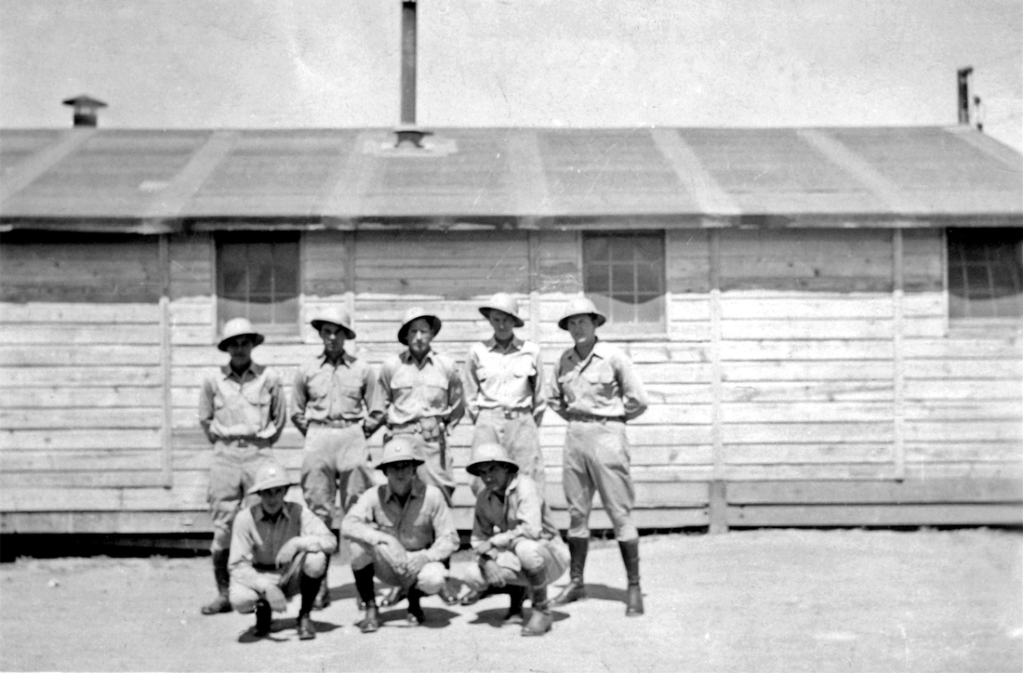
But being off on some secret facility caused one unexpected problem. It might be weeks before they got mail. Captain Bush probably violated a half dozen different security regs when he went into town and rented a mailbox at the post office in the name of all the soldiers stationed out there. So in addition to getting fuel and water, whoever was going into town also picked up the mail. And since they didn’t have a barber or a PX, the captain rotated the men going into town so they could buy the things needed and to get haircuts.
Soon, more MPs and Army Engineers arrived. Trinity Village was beginning to resemble a real live Army camp. No one had any idea why they were out there, why they were doing certain things, and so they just did the best they could.
Captain Bush was a good CO, and it’s obvious he cared about the troops under him. He looked at how to keep the soldiers going. Boredom was the enemy out there, and several soldiers there related that several times Whiskey came in. In an effort to keep the troops occupied, Bush tried to provide them with chances to play. Since they had horses, he found polo gear for the men. Few of the men had ever played polo, but they were game. They soon discovered they didn’t care for the polo gear, and used a broom and soccer ball instead.
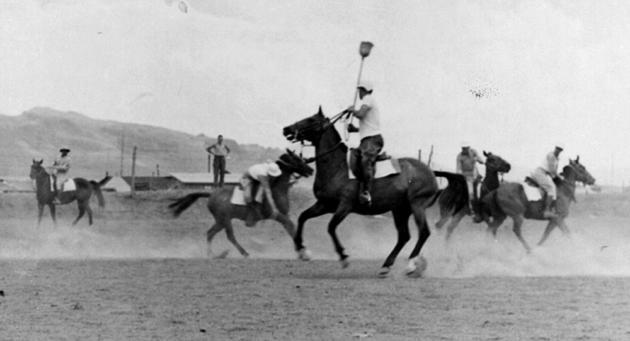
Captain Bush kept looking for diversions for his men. He did mange to get them movies. And since they had a soccer ball or two for polo, volleyball soon became a popular pastime under the New Mexican sun.
Perhaps the biggest hit was hunting. Since these were soldiers and a few of them were country boys, going into the wilderness was something they knew. Using Army Rifles, a couple of them would go into the nearby foothills and bag a deer or an antelope and bring it in. The animal would be butchered out and the meat would go to supplementing their diet.
Antelope meat was not a favorite but Venison steaks were another matter. They were a big hit and there always seemed to be seconds.
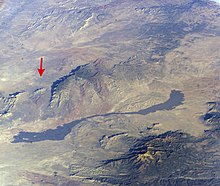
But the landscape was as alien to most of these young men as the Moon was. There were all manners of creatures slithering and crawling about that some of them had never seen. Davis related a story of going up to the Mocking Bird pass Guard Station to relieve the MP there. The MP there said he was surprised at all the “Crawdads” around since it was so dry. Davis had to explain to him those weren’t Crawdads, but Scorpions and the last thing you wanted to do was try to catch them.
Then there were the snakes. Almost every man out there carried a long stout stick in the event they had a close encounter of the worst kind with one. It wasn’t at all uncommon to see one gong through the middle of camp and the soldiers soon learned to not only watch where they stepped, but where they sat, and to check around in their tents for them.
The scorpions, which were more numerous than the snakes seemed to have a particular affinity for the latrines and more than a few troopers were brought to grief by them.
But the snakes provided the most stories.
One of the men who carried the big sticks for snakes was an eighteen year old from Brooklyn named Felix DePaula. DePaula sees this large bull snake trying to crawl under a pile of lumber. While a bull snake isn’t poisonous, if you’re the one digging around in the lumber and came across it, you’d most certainly set a new speed record across the desert. so he’d trying to get it out of there. He’s got his stick under the snake, and in the course of getting it out, the tip of his stick got hung up in the lumber.
The snake is trying to get off the stick, he’s turning and tugging on the stick to get it loose, and finally in frustration he jerked it up.
The pole comes out and the snake comes rocketing off the pole. He’d used so much force in getting his stick free the snake flew over a nearby building. Suddenly he’s hearing hollering and cursing. He goes around to see men wide eyed standing a fair distance away from a very upset snake, and looking at the snake and then up at the sky.
The building was the chow hall and they’d all been line waiting to go in when it comes hurtling down on them. They all thought that maybe a hawk had the snake and dropped it.
He never corrected them.
But life wasn’t all jam at Trinity. In a very harrowing incident, the Trinity personnel found themselves on the recieving end of a bombing exercise.
Because of the secret nature of the place, and that the Alamogordo Bombing Range was a real live training site for bomber crews, things were bound to go wrong. What had happened was a classic real world application of Murphy’s Law. Practicing night bombing, a site had been set up with lights so the bombers could see it from the air. When the lead bomber came in, it bombed the generator that was powering the lights. The rest of the bombers assumed Trinity, since it was lit, was the bombing site.
They dropped on Trinity camp. Fortunately the only damage was to the stables, a carpentry site, and a small fire resulted.
In addition to the flying snakes and dropping bombs, there were other dangers about. in an interview, DePaula related the following story:
We had another incident that wasn’t very pleasant. We almost lost two men. They decided to go ahead and take one of the Jeeps—it was on the weekend—they decided to take a Jeep and go for a ride. By this time, it was probably June or July. It was very, very hot out, very hot. Their Jeep broke down on them.
Now, if they had used their heads, they would have stayed with the Jeep because there are MPs patrolling the road all the time. Well, the country is flat enough to where they could see the camp up there, and they thought they could make it across the desert and walk to camp because it couldn’t have been too far. But they didn’t realize, not having any water or anything, six miles or seven miles in the desert is a long, long ways to go.
Well, the MPs found the pickup, or the Jeep, whatever they were driving. They didn’t find the fellows, so they could tell that they took off across the desert and tried to walk to camp. They could have stayed on the road. They could have stayed with the pickup and everything would have been fine. It might have been hot wherever they were, but it was better than—so we took off on foot, several of us, made a great big line and just walked across the desert.
We found one of them lying underneath a yucca plant in the shade. They took care of him real well. They could see the other boy had a yucca stick with his T-shirt on it and he was kind of waving it in the air. They got him. But if they didn’t find that pickup or Jeep or whatever it was that they were driving, and didn’t go out looking for those two boys, we might have lost them. I don’t know if we would have or not, because they still had a few miles to go before they could get to the camp. They just didn’t. They panicked and didn’t use their judgment. That’s all.
But it taught every one of us a lesson. Stay with your vehicle. Don’t try to cut cross country, especially in the hot weather like that was. That had to be June or July that they were trying to get across that desert. That was probably the worst incident we had down there where we possibly could have lost a couple of our friends.
By May of ’45, civilians started showing up. These were the men and women who had helped to build something so secret, few men even knew it they were working on it.
Almost instantly there was a problem. Almost all of the military personnel were more or less restricted to the area. The same didn’t apply to the civilians. They came in, did their job over the course of the week and then went home to Los Alamos for the weekend. Some of the soldiers had families, and most hadn’t seen them in a long time.
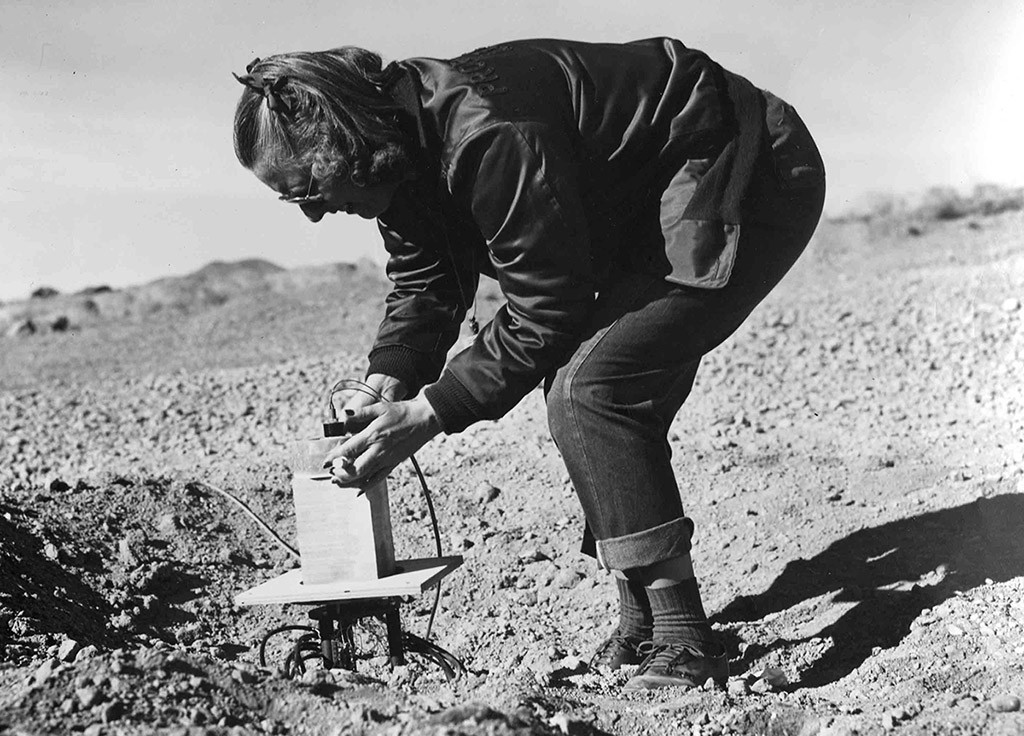
One of the more interesting things I found in my research was where the name “Trinity” came from. Robert Oppenheimer, the man who ran the project took it from the name of a poem from John Donne. he’d shared the poem with a former fiancée named Jean Tatlock. She’d killed herself the year before.
There were few women on the project and many found themselves working and surrounded mostly by men.
Lilli Hornig was a brilliant chemist. She had a good reputation, and when she applied for a position on the team, the first thing they asked her was “How fast do you type?”
She looked at them and said, “I don’t type.”
She eventually worked testing the solubility of different Plutonium salts. It was a humdrum task, even if it was important to national security. She’d later say, “It wasn’t terribly inspiring, and nobody actually really spoke with us.”
The secrecy of the project was hard on the families of the scientists and soldiers. Many were young and just starting out. The wives found themselves living with men who were tight lipped about what they saw, heard, and thought. mail was censored, and in some cases routed through UCLA so it appeared to be coming from anywhere except Trinity.
One of the big fears of the Atomic Bomb was that it wouldn’t work. While the idea behind an atomic bomb is simple, the engineering isn’t, and there were some real fears that when it was detonated, the TNT that would ignite the nuclear explosion might work fine, but due to some error someplace, a chained reaction wouldn’t start. If that occurred, the Plutonium that was the core of the bomb would be scattered for miles around the area. Since there was a limited amount of Plutonium in existence, every effort would have to be made to save it.
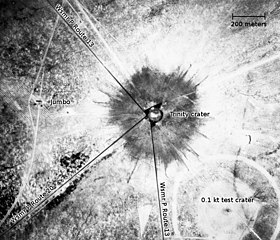
The answer was a stainless steel behemoth called Jumbo. Made by a company that made boilers for the navy. The bomb would be placed inside and it was supposed to be able to contain the explosion of the TNT and not allow the rare, precious, and deadly Plutonium out. Of course, if the Bomb worked, Jumbo would be vaporized.
Jumbo was delivered to Pope, New Mexico by rail, and then moved out to the Trinity site on a specially built, 64 wheel trailer. It was placed inside a large tower.
But as confidence in the bombs design soared, a decision was made not to use Jumbo. It was simply left hanging.
In May, a test explosion of 100 tons of TNT was conducted. Think of this as a dress rehearsal for the actual test. It would give the scientists a chance to conduct a test countdown and to calibrate the instruments for the actual test.
The explosives were stacked on a 20 foot wooden tower and a small amount of radioactive material was inserted in tubes throughout the explosives. What they wanted to do was get an idea of how the fallout from the actual blast might be spread out.
When the TNT was set off it completely destroyed the platform and created a small crater with some radioactive material inside.
The MPs and Engineers at the site still didn’t have any idea of why they were out there, and they believed they were seeing the testing of some kind of new bomb. They weren’t far off.
But as more and more people came in, they began to realize that this was no small thing.
On July 12, the plutonium core was delivered to the McDonald ranch house. Brig General Thomas Farrell was on hand to sign for it. He said, “I recall that I asked them if I was going to sign for it shouldn’t I take it and handle it. So I took this heavy ball in my hand and I felt it growing warm, I got a certain sense of its hidden power. It wasn’t a cold piece of metal, but it was really a piece of metal that seemed to be working inside. Then maybe for the first time I began to believe some of the fantastic tales the scientists had told about this nuclear power.“
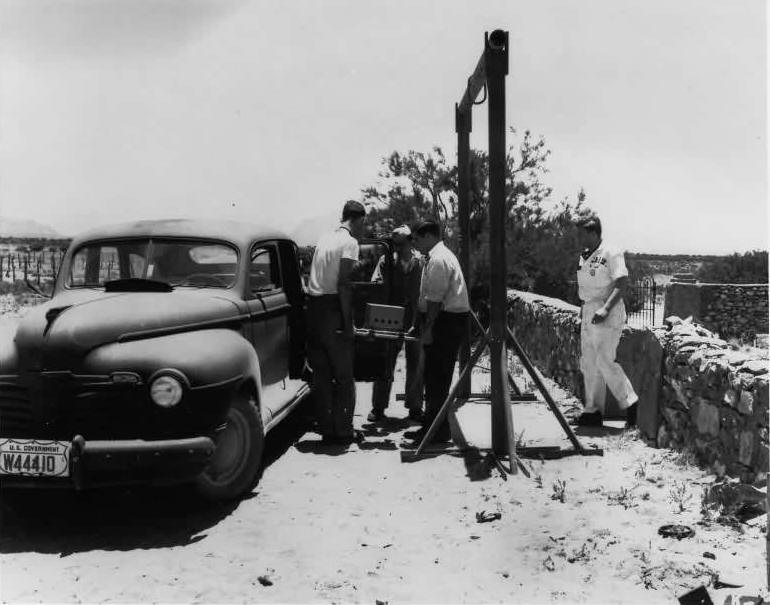
What had been the Master Bedroom in the ranch house was turned into a clean room. This is where the core for the bomb, or the “Gadget” as it was called was assembled. Special tools were used to put it together. Several of these tool kits existed, some of which were already on the island of Tinian where the bombers that would drop the bombs in combat were. Everything would be tested, tools, techniques, and of course, the Bomb itself.
On the afternoon of the 13th, the core was taken out to where the bomb body was waiting for final assembly at the tower. After a brief panic when they discovered they couldn’t put the core in, the men decided to wait until both the bomb and the core were at the same temperature. They did and the core went in smoothly.
The hard part done, the technicians went swimming in a water tank east of the Ranch house.
The next morning, the Gadget was raised up into the tower and into a shelter that had been built atop it. There, the detonators were hooked up. By 5 PM they were finished.
The worlds first Atomic Bomb was ready to go.
July 16th would be a strange day for Military Policeman, Cpl. Davis. It would be a day he’d witness two sunrises. He was detailed to run a technician up a road where the Tech would check for radioactivity. They wanted to make sure no fallout was settling to the west of the test.
I found something he wrote about that day and I’m including it here. The full text is available below, but this was his observations of that day. I apologize that I’m breaking it into sections, but I’m doing that for story flow.
Three wooden shelters, protected by earth and concrete had been built. From here, scientists could observe and run the explosion. VIPS were kept roughly 20 miles away from Compania Hill.
The test was supposed to happen at 4 AM in the morning but there was rain and lightening in the area. A hold into the countdown was implemented until the storms moved out. The rain would interfere with the distribution of fallout and with measurements.
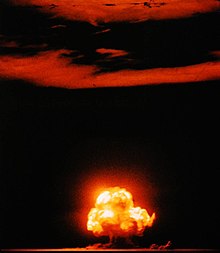
It was a 5:10 AM before the countdown picked up again. It was at 5:29:45 AM when the worlds first Atomic Bomb exploded.
DePaula picks up the narative by saying, “The night of the dropping of the bomb was a different story all together. We were all woken up and had to get out of our barracks and put our helmets on and our clothes and all. We were sitting behind a high bunker of dirt that was built out there. We were told the direction that the explosion is going to go off at, and we were given some welders’ goggles with shields to look at the blast, but we couldn’t look at the—they told us not to look at the blast until after we knew the bomb had been detonated. They never even used the word “bomb.” They just said after the “detonation” and all.
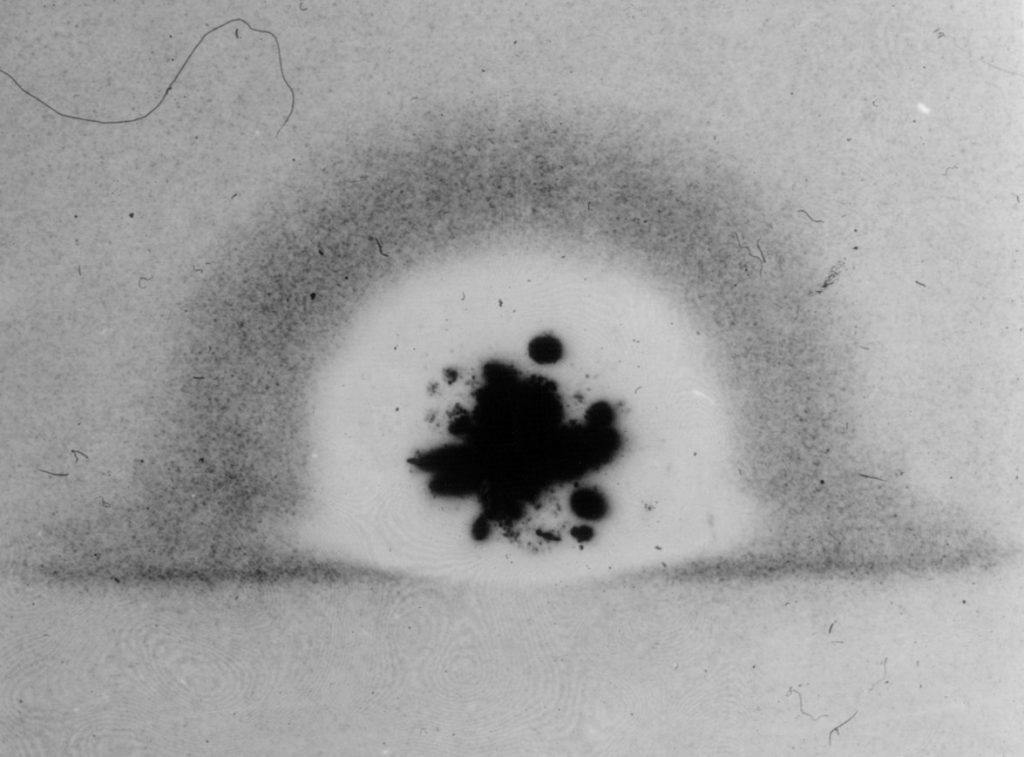
“When it went off, the whole canyon that we were in lit up like it was daytime. That’s how tremendous it was. Now, I have never been involved with any kind of explosives in my life except firecrackers at home. It really didn’t impress me too much. I was still an 18-year-old boy that did not know much about life.
“But we had a 35-year-old man whose last name was Borden. We used to call him “Pop” Borden. That man dealt with explosives in upstate New York where they would blast out tree trunks from the ground and work on roads. He had some kind of an idea of what an explosion could be like. I recall three days after the explosion, he was still like in a semi-trance, and telling everyone that was the awfulest thing he had ever experienced in his life. He said, “I don’t know how anything could ever survive for miles around with an explosion like that.” He really had an idea of the tremendous disaster that could be caused by detonating the bomb.“
Hans Bethe, one of the men who had worked on the gadget wrote, “it looked like a giant magnesium flare which kept on for what seemed a whole minute but was actually one or two seconds. The white ball grew and after a few seconds became clouded with dust whipped up by the explosion from the ground and rose and left behind a black trail of dust particles.”
Cpl Davis was ten miles away from the blast. What impressed him was the heat. “The heat was like opening up an oven door, even at 10 miles.” Here’s more:
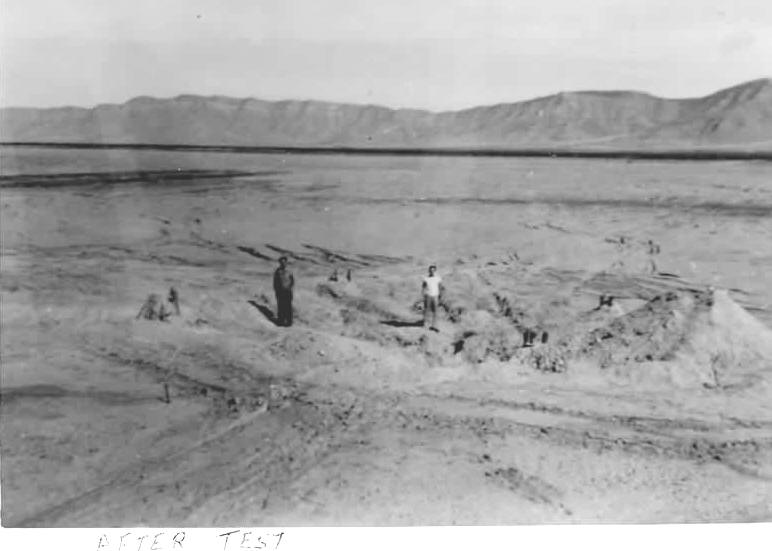
Dr. Phillip Morrison echoed the same sentiment. “Suddenly, not only was there a bright light but where we were, 10 miles away, there was the heat of the sun on our faces….Then, only minutes later, the real sun rose and again you felt the same heat to the face from the sunrise. So we saw two sunrises.”
The explosion did not go unnoticed.
A nearly blind woman some miles away had gotten up early. She reported having seen the blast. The sonic shockwave from the blast broke windows as far as 120 miles away and could be heard 160 miles away. The official report to a startled population was that a munitions storage bunker had exploded.
Davis continued with his account of that day.
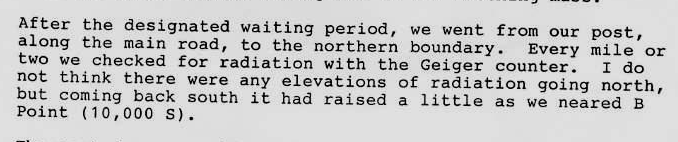
A few weeks later, there was no point in maintaining the cover story. The war in Japan ended with the dropping of not one, but two atomic bombs.
Things quieted down at Trinity after the explosion. Cpl. Marvin Davis said the day after the explosion, everyone talked about it but it was in hushed tones, almost as if they had trouble believing it themselves. It was sometime before he went out to ground zero, and then he had to wear a film badge and medics looked them over. Blood tests seemed to have been run constantly.
After that, it was mostly just keeping an eye on the site and turning away the curious.
Today, the McDonald ranch has been partially restored and the site is open to the public. One of the exhibits inside has the goggles and film badge Cpl. Davis wore.
A simple monument stands near Ground Zero. It’s at once the marker for one of humanity’s greatest achievements and a headstone for the people who died as a result of what was made there and in all the tests that came afterwards.
Let’s pray it’s never the headstone for all humanity.
ANOTHER PERSONAL NOTE: A story I’ve never proved or disproved concerned my old College Physics Teacher, Dr. Moe Morris. Story has it he was part of the team that helped build the bomb. I never asked him, he never offered it, but it’s a story I’d have liked to have heard none the less. Like I said, I don’t know if it was true or not, or just a story whispered among his students.
REFERERNCES:
Trinity Test itself – https://en.wikipedia.org/wiki/Trinity_(nuclear_test)
Trinity project – https://www.wsmr.army.mil/Trinity/Pages/TrinityHistory.aspx
https://www.atomicheritage.org/article/remembering-veterans-who-worked-manhattan-project
As excellent site to hear and read what people there or part of the project said: https://www.manhattanprojectvoices.org/oral-histories/felix-depaulas-interview-2008
https://www.atomicarchive.com/history/trinity/assembly.html
The Women of Trinity – https://www.theatlantic.com/sponsored/wgn-manhattan-project/the-women-of-los-alamos/580/
https://www.atomicarchive.com/history/trinity/afterwards.html
https://www.newyorker.com/tech/annals-of-technology/the-first-light-of-the-trinity-atomic-test
NOTE FROM THE AUTHOR: Like my blog and stories? Check out my novels available on Amazon. I have two out right now, The Cross and the Badge, and Against Flesh and Blood. A third novel, The Judas Tree will be coming out soon. Click on the novel names to be taken straight to them.
As always, thanks for dropping by and for your support. God Bless.
Discover more from William R. Ablan, Police Mysteries
Subscribe to get the latest posts sent to your email.
 William R. Ablan, Police Mysteries