
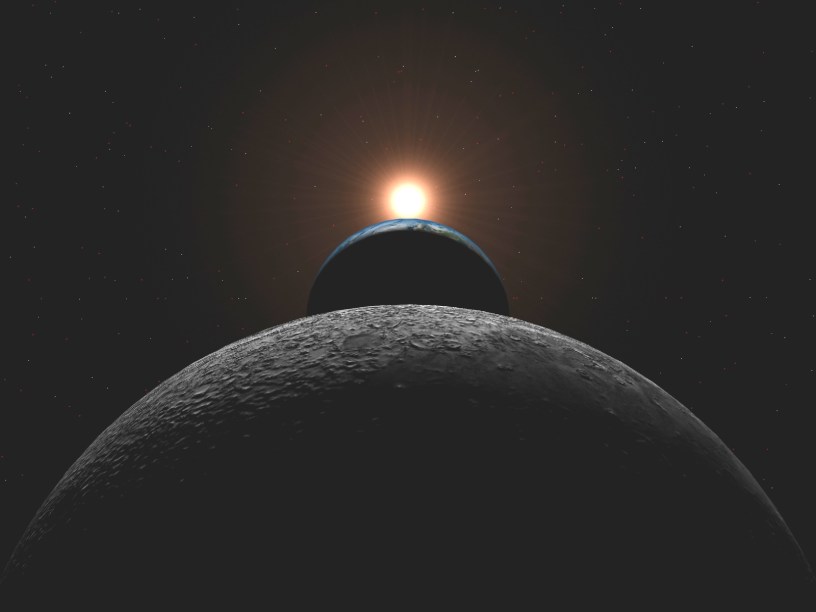
If you read my blog entry titled “Influences“, then you know that Arthur C. Clarke always was a huge inspiration for my writing. And 2001 is one of the books I’d place at the top of the list as helping to shape me into the person I am today.
Honestly, I haven’t read the book in almost twenty years. I started rereading it during the Gulf War, but my book got destroyed by the rain, and I never finished it. Now, years later, I asked for a new copy for Christmas.
Having finished other books ahead of it, I picked it up, hoping and praying the magic of the book hadn’t faded with the years. After all, when it was written, that was a very tangible future. But politics, lack of funding, and lack of interest on the part of everyone buried that potential future with a stake through its heart. And we’re also on the other side of that magical number, and there have been unmanned missions to Jupiter and Saturn, and we’ve learned a lot. I was afraid that the worlds it depicted just might not be accurate enough, or worse, the old magic had turned to fairy dust.
I’m happy to say, the book still retains its magic and power even after 50 years. I’ve spoken often about doing your homework when writing anything, and this book has most certainly held up because of that. First, there’s almost nothing, with the possible exception of HAL, that couldn’t be built or done with today’s technology. Discovery could be built. All the different technologies are just lying about waiting to be put together. Even HAL might be pieced together with what we’re doing today.
Some of the things I noticed that have come to pass is the flat screen portable computer. They called it a newspad. We call them tablets. Ours is so much better.
But what impressed me most is the description of other worlds. The only place Clarke got it wrong was in his description of Europa. He described it as an ice world EXCEPT for a band of rock around the equator. We know today that it’s ice from pole to pole, and most likely harbors an ocean. But drawings made through high power telescopes dating from before the book was written showed a white world, and the possibility of something running around the equator. Considering it was done waiting for the sky to be still enough to glimpse anything for a fraction of second, well that was pretty good.
The descriptions of Jupiter and Saturn are still mind boggling. Looking at the pictures from the Voyagers, Galileo, Juno and Cassini, I almost found myself wondering how Clarke knew that’s what it would look like. One thing not mentioned in the book is the Ring of Jupiter. Of course it wasn’t even suspected when the book was written, and it had to wait for the Voyagers to find it.
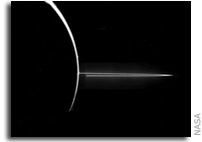
Equally impressive is the descriptions of Saturn and the it’s moon Iapetus. I recall as a student in college working at the observatory, after I’d finished the night’s program, and if Saturn was in the sky, I’d turn the large telescope towards it. Across millions of miles of space, I’d look at the incredible beauty of the planet and I remember thinking that God had spent extra time on making that dazzling world. But Clarke’s description of Iapetus fired my imagination.
In the book, it’s the ultimate objective of Discovery. I remembered how Clarke had written that on one side of it’s orbit around Saturn, Iapetus was six times brighter than on the other. It is, you know. When the book was written, no one knew why.
For my money, I thought that maybe sometime in the past, a large dark colored asteroid (there’s plenty of those we know about) had crashed into the ice covered moon, and splattered itself across the distant surface. Clarke used this remarkable brightening and dimming to place his stargate on that distant moon where it had waited for three million years. In the book, we’re looking at the end product of a feat of cosmic engineering.
It had to wait for the Voyagers and Cassini to solve the riddle. The first pictures of that distant moon taken from the probes showed a battered globe with what looked like soot sprinkled across the leading side of it. Since that small object is in what we call tidal lock (it keeps the same face always towards Saturn), the face with the darkened surface is always plowing straight ahead in its orbit. For a few years no one could figure out where the black material was coming from. But in a slightly higher orbit is a dark colored moon, not unlike the asteroid I’d thought might be responsible. Impacts with meteors is knocking material off its surface. The material spirals down towards Saturn, but never makes it because along comes Iapetus and plows the material up onto its surface.
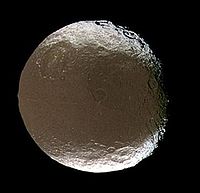
But Cassini did show an unusual structure on the surface of Iapetus. Sorry, it wasn’t a big black slab, but a mountain range running right around the equator of the tiny moon. No one knows how it formed but there’s plenty of speculation.
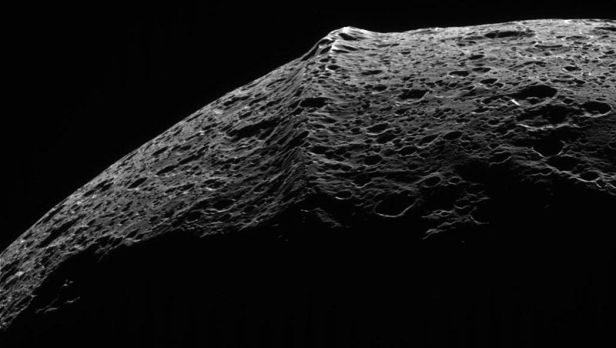
I suppose we’ll have to wait to go out there and figure it out.
And that’s where the real magic of this book comes in. It speaks to that sense of mystery in us. While Bowman is a long ways from a fully developed character, I could feel his isolation and his apprehension as he came face to face with the incredible. And the sense of awe and wonder he felt has not diminished one bit.
Maybe it will help fuel the generation of explorers that will go out to Saturn and face those wonders head on.
I wish I were one of them.
Discover more from William R. Ablan, Police Mysteries
Subscribe to get the latest posts sent to your email.
 William R. Ablan, Police Mysteries