
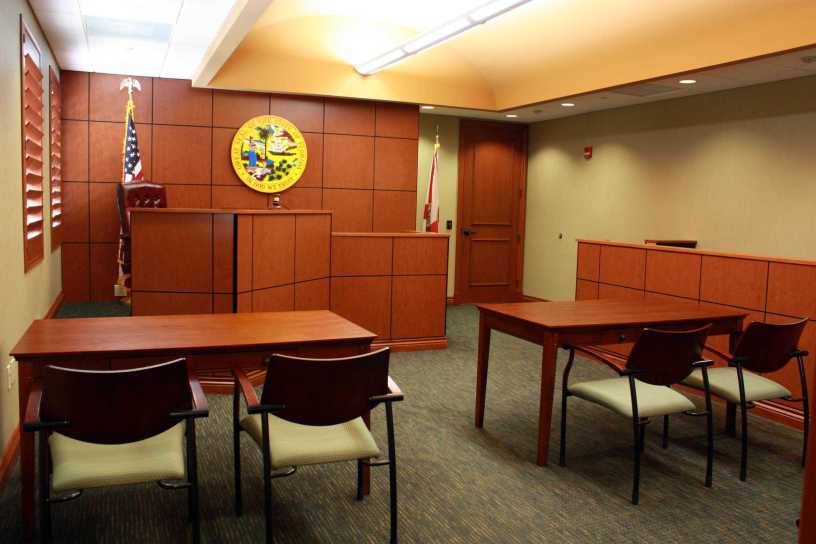
One of the things I’ve found useful in my writing is to give the reader a primer for something that will happen later on.
In The Cross and the Badge, the first book in “The Lawman” series, I wrote an entire training session on planning, entry techniques, and the like. Several chapters later, I actually have an operation where all this training has to come together, and Will Diaz and his colleagues have to go in after a barricaded suspect.
In Dead Friends, or at least in the rough draft, I have RJ teaching an entire class on courtroom testimony. But it’s a lot more than that. It is also a primer on how a case is handled through County Courts in the United States.
I realize that not all my readers and followers are from the States, so things are often times different in other countries, so this might not apply to your country at all.
What RJ does in the novel is sit down with the judge, the DA, and an attorney from the Public Defender’s Office, and they put together a presentation for local police officers on how a case is guided through court.
He also introduces the players in a court case such as:
- The Judge – The individual who is responsible for ensuring that a case is guided through the process in a legal and fair means. In most cases, it will also be the judge who determines the punishment for the case.
- The DA or Assistant DA – Responsible for establishing the facts of a case based on testimony and physical or forensic evidence, and proving the guilt of the accused.
The DA has to prove “beyond a reasonable doubt” that the defendant did something. He or she does that through the use of testimony and evidence.
- The Defense – Is responsible for defending the defendant. He or she is charged with the cross-examination of witnesses and verifying their story or invalidating their testimony. They also need to look at the admissibility of evidence (from witnesses or physical evidence), and disputing facts established by the prosecution. Worse case scenario, they can negotiate on behalf of the defendant for a reduced sentence, or a lesser offense.
Where the prosecution has to prove beyond a reasonable doubt that the defendant broke the law, the defense is tasked with finding and proving that doubt.
An example here might include expert testimony. The DA will have the results of say a certain scientific test ran on something. The defense can take the same evidence, give it a different expert, and see what their results are. One of the simple facts of science is if two people do the same thing with physical evidence and come up with two different conclusions, then something is wrong with that evidence or the conclusion. That’s one way to provide reasonable doubt.
If they fail to provide that doubt, then the defendant is found guilty. If they do provide and prove doubt in a case, then the defendant must be found not guilty.
- The defendant – Whoever is accused of breaking the law.
- The Witness – Whoever has something to say regarding the case. In most cases, it’s the officer or detective that investigated the case. It can also be people impacted by what the defendant did. Other times it’s whoever happened to be about and saw what happened, or had some knowledge of the event. It can also be an expert on whatever tests were run and their conclusions.
In the United States, whatever proof the prosecution has on a case, the defense gets it as well, and vise versa. It’s called “discovery” in most cases. This way both sides can frame questions, plan for the prosecution or defense of a case, and provide for other or any witnesses. This way the jury is provided with as much info as they can get to decide the case.
Something that’s always an interesting dynamic is that you can have four people who saw the same incident but come out with four different stories. It’s not that they’re lying. It’s just that we’re all different people and we see things differently. It also depends on where we were, and so forth.
A good example is a commercial I’ve seen recently on TV. You’ve got this bearded guy in a hoodie with tats, who grabs a woman’s purse, and drags her backward where she falls onto the sidewalk.
From that perspective, this looks like a botched purse snatch, and possibly even an assault since she falls on hard concrete.
But then when you look at the same scene from a different perspective, she was about to step out in front of a speeding car. The guy in the hoodie grabbed for her and yanked her back by the only thing he could grab which in this case by her purse strap. So from one person’s viewpoint, it looked like an attempted theft. From the other, it was someone saving her life.
- The Jury – Those unlucky individuals who get to sit for several hours, possibly for several days, listening to testimony upon which they get to determine the ultimate fate of the accused. Just for the record, I have yet to sit on a jury (not that I’m never called). When it’s revealed that I’m a retired police officer, I’m the last person the defense wants there. What’s strange is that I’m also the guy who would be the most objective.
Part of what the prosecution and the defense wants is to get an “impartial.” jury. In short, people who have a worldview not colored by whatever the case concerns. My wife has a little experience in that. She actually got to be examined by the DA and defense, and when it was discovered she was the wife of a police officer and one who had been injured in the line of duty, she was excused because that’s what the case was all about. On the other hand, she served on a jury where the defendant had written bad checks.
In the class, RJ also runs through some of the different phases of the case as it’s presented.
- Arraignment – Pretty simple. This is the defendant having the chance to say, “Yes, I’m guilty” or “No, I’m not.” Sometimes he or she will have a lawyer present, and they will do that for them. Sometimes, the case can go to trial right there, especially for minor offenses such as speeding, etc. It’s rare that happens, but it can, especially if witnesses, etc., are present.
- Pre-Trial Conference – A lot more complicated. In this, the evidence is looked at deeply for the first time. Concerns such as chain of custody are looked at. The evidence is presented, witnesses and statements involved, and does the evidence support the charge? This is a really good place to find out if you’ve doted your ‘i’s’ and crossed you ‘t’s’ when it comes to evidence, and a good defense attorney can have a lot of fun here. Here’s an example:
In The Cross and the Badge, I mention a sexual assault case that actually occurred. I did change the ending of that case so that, in the book, the accused played “Let’s Make a Deal.” In real life, it happened a little differently. The sexual assault happened with a pistol pointed at the back of the girl’s head. I got a good description of the weapon, and we were able to get a search warrant for the defendant’s car and house based on that. However, something no one caught was the description I had really didn’t make it into the search warrant. I reasoned it was most likely a Ruger 22 automatic or a Lugar style weapon. I could pretty much discount the latter since most of those are collectibles, and a cheap hood usually doesn’t run around with one. At the time, the Ruger 22 was very popular. Well, it never got spelled out properly that we were looking for a 22 caliber Ruger, black in color, etc. When we searched his house, we found a 22 Ruger pistol. But because how we arrived at it being a Ruger 22 wasn’t spelled out in the warrant properly, the pistol got thrown out as evidence. (In short, we weren’t specific enough. The warrant just said a black in color, semi-auto pistol.)
What difference would that make? The difference between sending the guy away for twenty years and four because now it dropped from First Degree Sexual Assault (involving a deadly weapon) to Second Degree. While he was found guilty of Second Degree Sexual Assault, he only did time for a few years instead of a few decades. Kudos goes to the Defense Attorney for catching it. I learned a lot from that mistake.
- Trial – This is the part most people are familiar with. You’ve got twelve people who have to evaluate the evidence and testimony and reach a conclusion. What people don’t often see is the jury selection process and how it works. I’ve mentioned some of this, but some of the other things that MIGHT get you disqualified as a juror on that case are things like do they know the defendant or the witnesses. Have they ever been accused of or convicted of the same crime? Even down to religious viewpoints on judging someone can get you dismissed. And that’s assuming they even get that far. You can have a hundred people show up for jury duty, and three-quarters of them will be sent home before the attorneys even see them. Those that are called into the courtroom may just sit there without even being called up. I’ve seen jurors excused for the simplest of reasons, but don’t count on it. A case I worked, and in which I was the star witness was going to trial. My brother was called for jury duty. I told him to say he was my brother and the defense would surely object to it. Guess who ended up serving on that jury.
The reason I felt I needed to spell it out in the novel is this. I have an arrest made of a drug pusher. The defense is questioning everything, even down to the credibility and honesty of the witnesses, the validity of scientific tests and so on. I wanted the reader to understand that a properly run case through the courts is not a free for all as often seen on TV or movies, but a structured, ordered process.
I wanted to lay out the framework and establish the rules long before we ever got to that part of the novel.
Discover more from William R. Ablan, Police Mysteries
Subscribe to get the latest posts sent to your email.
 William R. Ablan, Police Mysteries